
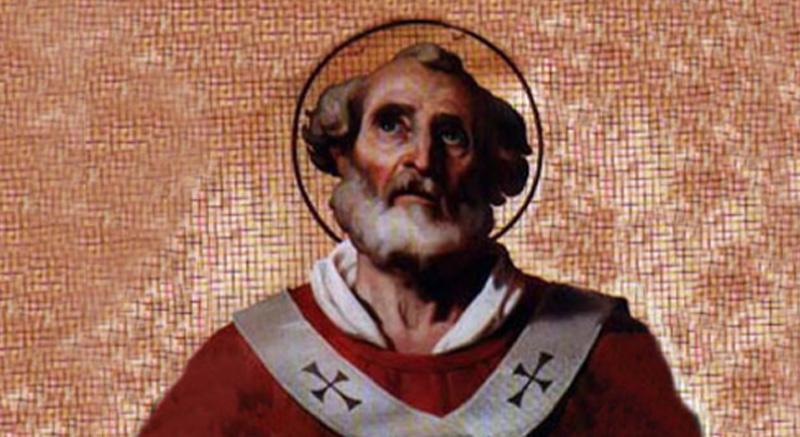
The following are translations of key letters in the Acacian Schism and will be added to over time.
Of key interest is Epistle 80 written by Pope St. Hormisdas to Patriarch Epiphanius of Constantinople. The letter, which was written in 521, is Pope Hormisdas coming to terms with the reality that even with imperial force (detailed in other letters), only Constantinople and its suffragan bishops were willing to sign the Libellus of Hormisdas. In reaction, Pope St. Hormisdas asks that Epiphanius of Constantinople accept libelli from bishops who would not sign the original libellus and, being that these libelli would be composed by the bishops desiring a resumption of communion with the imperial Church, he gives stipulations on what these libelli must contain never once mentioning the Petrine claims but rather focusing entirely on proper Christology and trinitarian theology,
Now, it should be noted that the language in the original libellus only lends itself to a pro-Vatican I understanding of papal prerogatives if one starts from that viewpoint and it has not, traditionally, been seen as proof of papal infallibility. Case in point, when Bishop Vincent Gasser wrote his Relatio, which is the official interpretation of Pastor Aeternus, he did not include the original Libellus in his three examples a belief in papal infallibility. Oddly, though, he included the version of the libellus from Constantinople 869 session I (which had only a dozen bishops and legates in attendance) which is tailored towards the events of the Photian Schism) as well as the Councils of Lyon II and Florence.
List of Letters (Click to Move to Section)
Ep. of Pope Anastasius II of Rome to Emperor Anastasius c. 496
Libellus of the Alexandrian Clergy Dioscorus and Chaeremon to the Roman Legates c. 497
Ep. VII of Symmachus to the Eastern Bishops October 8, 512
Ep. VII of Hormisdas to Bishops Ennodius and Fortunatus August 11, 515
Libellus of Hormisdas August 11, 515
Ep. XXVII Hormisdas to Emperor Anastasius April 3, 517
Ep. XLII Emperor Justin to Hormisdas September 7, 518
Ep. XLIV Justinian the Comes to Hormisdas September 7, 518
Ep. XLIII John II of Constantinople to Hormisdas September 7, 518
Ep. XLV Hormisdas to Emperor Justin Late 518 or early 519
Ep. XLIX Second Libellus to Our Ambassadors January 519
Ep. LVII Hormisdas to Justinian the Illustrious Mid-February 519
**Ep. LXI Ecumenical Patriarch John II the Cappadocian to Hormisdas March 27, 519
Ep. LXV Report to Hormisdas from Dioscorus the Deacon April 22, 519
**Ep. LXXX Hormisdas to Epiphanios, Archbishop of Constantinople March 26, 521
Ep. CXX Justinian the Illustrious to Hormisdas September 17, 520
**Ep. CXXI Copy of a Report of Epiphanius, Bishop of Constantinople July 9, 520
**Ep. CXXXIX The Monastics of Syria Secunda to Hormisdas c. 517
**Ep. CXL Hormisdas to the Monastics of Syria Secunda February 10, 518
Anastasius II of Rome to Emperor Anastasius, c. 496
To Anastasius augustus, most glorious and merciful son, [from] Anastasius the bishop37
I announce the beginning of my pontificate for the first time with peace offered to the people. Consequently, I present myself to Your Piety as a humble beseecher for the catholic faith. First, I trust, divine favor has approached me in you. [I mean] that the harmony of your most august name offers secure aid in me, so that—just as the outstanding word of Your Piety shines out through all races in the entire world—so the see of most blessed Peter holds onto its leadership, having been assigned it in the whole church by the Lord God, through the service of my humble self, as [humble] it always remains.
Nor on account of one death did the Savior’s tunic, woven as one piece [cf. Jn 19:23], suffer the uncertainty of evil division for a long time, which [tunic] was the only one that was not able to be torn apart, on account of its strength, with Your Serenity governing the republic,38 especially to one who had in your own life so much zeal for true religious belief that, as most reliable rumor had it, no one even among the head priests is said to have given more protection to the rules set down by the holy Fathers for the church. We trust that such holy zeal has increased with the greatness of imperial rule.
1. And so we are dispatching an embassy on behalf of Christ, lest we allow those whose merits or actions cannot be hidden from that Judge to whose judgment they have now been committed, be named in public for offense or scandal. Nor can that rash presumption still insinuate itself there in the mortal body in which not only confession has made known the merits of individuals, but even the secret of its silence cannot be hidden. For both our predecessor Pope Felix and even Acacius are there beyond doubt, where each cannot lose the quality of his merit, under such a Judge.
2. And so as the most blessed apostle Paul warns us, lest anything be a stumbling block for this reason in the church, when we try to judge what we cannot [cf. Rom 14:13] concerning those who have died, Your Tranquility should recognize what must be observed. For he said of those who presume to judge those things which pertain only to God: “for none of us lives for himself or dies for himself. For if we live, we live in the Lord; if we die, we die in the Lord. For whether we live or die we are the Lord’s. For this reason, Christ rose from the dead, that he should rule both the living and the dead. But why do you judge your brother? Or why do you scorn your brother? For we shall all stand before the judgment seat of Christ. For it is written: We live, said the Lord, when every knee shall bow to me and every tongue confess to God [Is 45:23]. And so each of us shall render his account for himself to God. Therefore, let us no more judge one another but judge this instead, that you do not pose a stumbling block or a cause of offense for your brother” [Rom 14:7–13].
Therefore, the blessed apostle issues a warning, that no one, by presuming to judge those things which no one can judge better or more truly than God, should employ rash acts of daring, and on account of this that the peace and unity of the church be disturbed. For in the Book of Kings, it is said: “For God does not see as humans see: because humans see the face, but God sees into the heart” [1 Kgs 16:7]. Likewise in Book 1 of Chronicles: “And now, Solomon, know the God of your fathers and serve him with perfect heart and willing mind, since God looks into all hearts and knows every thought” [1 Chr 28:9]. Likewise, in Ezekiel, “The Lord God says this: So you have spoken, house of Israel, and I know the thoughts of your spirit” [Ezek 11:5]. Whence also it is said in the Gospel about the Lord [our] judge: “But Jesus, knowing their thoughts, said: Why do you entertain evil thoughts in your hearts?” [Mt 9:4].
3. Therefore, we beseech Your Mercifulness that in particular the name of Acacius should not be spoken, as for many reasons it has aroused a cause of offense or something of a stumbling block in the church. Let it not be spoken of in special mention, since, as I said, in the general category of priests the special merits of each cannot be hidden from that Judge who knows what should be awarded to each in accordance with the tally of his allocated merits. And to [that Judge] alone have thoughts been revealed.
But so that it does not perhaps seem burdensome to Your Mercifulness to list them one by one—how many were the trespasses and presumptions of Acacius, about each case against Acacius, what kind it was—we have given the fullest information to Cresconius and also Germanus, my brothers and fellow bishops,39 whom we have sent to Your Serenity. Your Mercifulness can reconsider them in more detail, if it pleases Your Piety to investigate more fully, lest in any suggestion of ours the truth might appear to be incomplete. And so, in keeping with your divine wisdom, you can see most clearly that the apostolic see went ahead with such a sentence against Acacius not out of pride or high-mindedness, but aroused more by zeal for the Divinity against his actual crimes, as far as we can be sure, beyond that judgment which alone cannot be deceived.
4. But we do not wish there to remain controversy in the church, humbly beseeching you, since conflict is greatly to be avoided, as is said in Proverbs: “Conflict arouses hatred but all those who do not dispute, protect [their] friendship” [Prv 10:12]. And also the apostle to the Corinthians: “For since there are rivalries and conflicts between you, surely you are of the flesh and behave as men?” [1 Cor 3:3]. And likewise to the Philippians: “Therefore, if there is any consolation in Christ, if there is any talk of love, if there is any fellowship of the spirit, if there is any affection and pity, make my joy complete by all speaking the same thing, having the same love, holding nothing in dispute nor out of empty pride but in humble mind valuing each other as better than yourselves, each looking out for not his own interests but those of others” [Phil 2:1–4].
5. I especially indicate this, however, to Your Serenity, most praiseworthy and merciful son, augustus, that when the charges of the Alexandrians are laid open to your ears of good faith, by your authority, wisdom, and your divine warnings, you make them return to the true and catholic faith.40 For what should be held in the catholic religion, according to the definitions of the Fathers and the preaching of all the priests who have flourished in the church, if you command this also, we will renew it for those who are learned by pressing it into memory. We will offer it to the unlearned to be learnt in accordance with our office of teaching, so that no boasting of the intelligent or crookedness can be heard, apart from these [instructions].
6. But we preach on behalf of the apostolic office (more particularly for the love of your empire and blessedness which could attend on [your] kingdom) that, as is fitting and as the Holy Spirit dictates, obedience should be offered to our warnings, so that all good things may befall your republic, as is promised in Exodus: “If you hear the voice of the Lord your God, and you do what is pleasing to him and obey his commands and protect all his statutes, I will not inflict on you every disease which I inflicted on the Egyptians: for I am the Lord who saves you” [Ex 15:26]. And there again the most powerful trumpet sings: “And now Israel, what else does the Lord your God demand of you, than that you fear the Lord your God, and you walk in all his ways, and you love him, and you serve the Lord your God with your whole heart and your whole soul, keeping the commandments of the Lord your God and his statutes, which I give to you?” [Dt 10:12–13]. May Your Piety not despise me for mentioning this too often, keeping before your eyes the Lord’s words in the Gospel: “The one who hears you hears me, and he who rejects you rejects me, and he who rejects me, rejects the one who sent me” [Lk 10:16]. For the apostle too, agreeing with our Savior, says thus: “For this reason, the one who rejects these things, rejects not a human being but God who gave his Holy Spirit to us” [1 Thes 4:8]. The heart of Your Mercifulness is a consecrated chamber for public happiness, so that through your presence, which God ordered to rule over the lands as his proxy, harsh pride may not resist the Gospel and apostolic teachings, but the things that bring salvation may be fulfilled through obedience.
7. For according to the custom of the catholic church, Your Serenity’s most holy heart should recognize that none of these people whom Acacius either baptized or ordained as priests or deacons according to the canons attract any share of injury from the name of Acacius, through whose sin perhaps the grace handed down in the sacrament might seem to be weakened. For even baptism, which might be given far from a church, whether by an adulterer or a thief, arrives untainted to the one receiving the gift. Because that voice which spoke through a dove ruled out every stain of human contamination, when it spoke declaring: “This is he who baptizes in Spirit and in fire” [Lk 3:16]. For if the rays of that visible sun, when they pass through fetid places, are stained by no polluting contact, how much more will the power of Him who made the sun visible not be limited by any unworthiness of the minister? For Judas too, whatever he did among the apostles through his entrusted office, although he was sacrilegious and a thief, the beneficence he gave (though unworthy) felt no lack for this reason, and the Lord declared this very point in a loud voice. “Scribes,” he said, “and Pharisees sit on the seat of Moses: do what they say, but do not do what they do. For they speak but do not act” [Mt 23:2–3]. Therefore, whoever seems to act on behalf of his office, ministering anything to the profit of people in the church, this is all contained in fulfilling the effect of the Divinity in such a way as Paul affirms, through whom Christ speaks: “I planted, Apollo watered but God gave growth. And so it is not he who plants anything, nor he who waters it, but God who gives growth” [1 Cor 3:6–7]. So it is no cause for complaint who preaches or how he does it, so much as the one whom he preaches; so much so that he affirms that even those hostile to Christ preach him well, and cast down the Devil himself down by their evil, and he falls headlong without end by this same [preaching].
8. Therefore, in this way Acacius too, whose name we say should be silenced, harmed only himself by serving good things badly. For the inviolable sacrament, which was given through him, made his power complete for others. But if the suspicious curiosity of some people goes so far as to imagine those sacraments to be ineffectual which Acacius presumed to perform after Pope Felix offered his judgment, and so to fear those who had accepted the mysteries he handed down either in ordinations or baptism, let them remember (lest the divine gifts appear a laughing stock) that in this respect the discussion above similarly applies, because the accused did this after taking up for himself the priesthood, by which he gained his power to conduct the mysteries. By that [action] also the guilty person harmed none but himself. For what David sounded on his horn referred to him: “But God will smash the heads of his enemies, the hairy scalp of the ones who go on with their sins” [Ps 68:21]. For pride always spells ruin for oneself, not for others, as the whole authority of heavenly Scripture testifies. But even the prophet says through the Holy Spirit: “For he who practices deceit41 will not live in my house” [Ps 101:7]. And so, since the condemned [sc. Acacius] assumed the name of priest for himself, the swelling of pride42 was brought down upon his head, because no one who thirsted for his gift in the sacraments was excluded. That soul alone which had sinned was harmed, by the fitting judgment of his own guilt, as the instructions throughout the Scriptures frequently testify. And so, after excising human zeal and craftiness, although the weakness of those in positions [of power] is still present, offer to our God one apostolic and catholic church, with the approval and authority of the emperor, in accordance with our prayers. Because He alone is the one by whom you can triumph eternally, not only on land but even in heaven.
May Almighty God keep your reign and your health under eternal protection, ever most praiseworthy and merciful augustus.
Footnotes:
37. Sc. Anastasius II, bishop of Rome (496–98). Thiel, 615–23
38. Lat. Res publica, which here and elsewhere in this volume we have translated as “republic.” The term refers to the empire, East and West.
39. Also, the bearers of text 2.
40. On the problems in Alexandria at this time, see our introduction to this chapter.
41. Lit. “pride” (superbia).42. Again, superbia
Dioscorus and Chaeremon to the Roman Legates, c. 497
Libellus which the ambassadors of the Church of Alexandria delivered to the dispatched legates to Constantinople from the city of Rome.43
[From] Dioscorus, the priest of the revered Church of Alexandria, and Chaeremon the reader, who serve as respondents of the same church [of Alexandria] to the most glorious and excellent patrician Festus44 and the revered bishops Cresconius and Germanus,45 who were sent on an embassy from the city of Rome together with his authority to the most merciful and beloved-of-Christ, Emperor Anastasius.
Venerable saints of the church of the city of Rome and of Alexandria have always kept the peace, not only in the correct and stainless faith, by which the homily of salvation was preached among them, but also in divine ministry. Indeed, since the foundation of the faith in each city was built by one man—we remember Peter the blessed apostle, who was imitated in every respect by the holy evangelist Mark46—in such a way that if it ever happened that a certain council of bishops were to be held on a matter of doubt, that most holy man who presided over the Roman church chose the most revered archbishop of the city of Alexandria to take his place.
But the enemy of humankind, to whom good things are hateful, who was always lying in wait for our ruin, in a wicked rage was not slow to sow tares through his own assistants among each [church] so that he could bring about discord in such harmony. For while the most wicked Eutyches believed and was trying to teach against the faith which was preached among the most blessed apostles, it happened at the same time that Leo, leader of the apostolic see, then dispatched a letter to the Council of Chalcedon. The translators of the letter were those who were then followers of the Nestorian heresy, along with Theodoret, bishop of the city of Cyrrhus, and they proved the aforementioned letter stood against that faith which the 318 venerable Fathers had promulgated. They offered no small opportunities as well to these men who championed the blasphemies of the same most abominable Nestorius, in such a way that they alleged very boldly that the same Nestorius had thought nothing that was perverse. For these reasons, therefore, our people, beloved of God, were offended and figured that the Greek translation had the same meaning as the Latin, and we separated ourselves from union with the Roman church. And the Roman overseer,47 thinking we had conspired against that faith that was handed down by the most blessed apostles, suspended himself from communion with us.
However, wishing to satisfy His Holiness that we hold fast to the same faith as the most blessed chief of the apostles Peter and his most blessed disciple Mark believed, and the 318 revered bishops afterwards promulgated, our church took care to dispatch legates to the city of Rome. But there a certain person of our city48 who was
found disagreeing with the right faith and being estranged from it for various reasons was also seen to arrange that no facilities be offered for the reception of legates. Those who were not admitted to the face of salvation were turned away without any ado.
But a short time earlier Photinus, the pious deacon of the holy church of Thessalonica, joined with us in discussions about peace between the churches and said that he had been dispatched a short time ago by Andreas, the most holy archbishop of the church of Thessalonica, to the Roman Pope Anastasius. Photinus affirmed concerning these matters which particularly offended us that he was satisfied with the translation of the letter by the aforementioned leader of the Roman church, because the errors in the translation of the letter were of course completely approved, but the Latin letter itself corresponded with the faith promulgated by the 318 holy Fathers. Especially he recounted what had been said by the same overseer about his rejection of those [mistakes] which were put into the translation and of those men also who tried to destroy those things, to the satisfaction of those who do not neglect to preserve the correct and stainless faith.
Fully restored by this and longing to recover the former state of harmony, we preferred also to be informed by you if those things that Photinus, the religious deacon, told us were true. We wanted to meet Your Holiness and have a conversation about all these matters. But Your Holiness, not once but often, deigned to educate us in interpreting the letter and its introduced errors, which were not expressed in the Latin text. On this account we have beseeched you to accept our confession of faith, for which we are dispatching an embassy of our revered church. This faith also the most holy archbishop made known everywhere and received replies of approval from everyone.49 But if you see that also your holy church agrees with this faith, may you order us to consent, so that when scandals are removed from our midst the revered churches, both of Rome and Alexandria, may return to their former state of unity.50
And we offered you this confession of faith containing the following, the one true and correct faith by divine inspiration of the Gospel and apostolic proclamations, which the 318 venerable Fathers who gathered at the Nicene synod promulgated and to which also the 500 equally revered pontiffs51 assented when they met together in the royal city [sc. Constantinople]. Following this [faith] the Fathers who gathered at Ephesus, by approval also of the most holy Celestine, pope of the apostolic see, condemned the sacrilegious Nestorius, inflicting punishment on those who attempted to set up another faith. We too condemn with the penalty of anathema that Nestorius, together with Eutyches, as believing things contrary to those which are said above. We accept the twelve anathemas which Cyril of venerable memory, the former archbishop of the Church of Alexandria, wrote.52 We confess the only-begotten son of God, and God who was made human according to the truth, our Lord Jesus Christ, consubstantial with the Father according to his divinity and consubstantial with us according to his humanity. He descended [from heaven] and was made flesh by the Holy Spirit, born of the virgin Mary theotokos, that is, the God-bearer, one son not two. And we speak as well of the miracles and sufferings of the one, onlybegotten son of God, which he undertook willingly in the flesh for our sake. But those who introduce division or confusion or any delusion we do not accept in any way whatsoever, because that incarnation, which the God-bearer bore from herself in truth, did not make an increase in the Son. For the Trinity remained, even in the incarnate Word of God, which is one of the Trinity. And so we wrote down those facts, not making a new faith but wanting to satisfy you for the sake of harmony. But everyone who thinks otherwise or has thought so, either now or ever in any place or in any council, we strike with the punishment of anathema, but especially Nestorius and Eutyches and all those who agree with them.
Therefore, Your Reverence, upon accepting our faith, has said he will relay this to the leader of the Roman church, Anastasius, whom he mentioned was also prepared to make satisfaction to those who had been sent over by us for this cause. He was also affirming that Dioscorus, Timothy, and Peter, former archbishops of our city, believed things contrary to this faith, and that their names should not be mentioned in the diptychs. We have demanded the opposite: that either those who oppose them should be produced who can assert and demonstrate that they oppose them; or else, if those who could convict them cannot be found, he should agree to let us offer satisfaction on their part. If we demonstrate and can prove that they held fast to this faith, they shall make it known. And they shall hand down our aforementioned ancestors and archbishops, Timothy, Dioscorus, and Peter [sc. in the diptychs]. But Your Holiness refused, saying that he had not been ordered by the overseer of the apostolic see to make an investigation into these persons.
For the sake of this matter, we call you to witness before almighty God and our Savior Jesus Christ—who was made flesh and born of the holy virgin and God-bearer Mary, and who willingly represents and undertakes the simultaneous bringing to glory and servitude of the faithful—and before his holy angels this same stainless faith which is from him: that when you arrive in the city of Rome, with God’s indulgence, you will present this little document53 to Anastasius, overseer of the apostolic see, which was presented to you on the part54 of the holy Alexandrian church. The result will be that His Holiness, upon reading what should please him, deigns to make [this] clear, whether in the letter given to our most holy archbishop or through some intermediary. For since by this holiness the confession of the right faith, which was ordained by the blessed Fathers, had been preserved, we declare ourselves prepared to dispatch ambassadors to the city of Rome, men who ought to act on behalf of the unity of God’s holy churches.
But we trust in our Lord Jesus Christ that His Blessedness [Anastasius] will agree with this faith, according to those things which were attached in the answer, that he may value our people also as his own and let him bring his concern to their rule, in his longing to prove useful to everyone, according to God. But we have kept a copy of this little document with us, thinking it necessary that—if there should be any delay whereby the unity of the holy churches does not come about, in the event of the glorious [second] coming from heaven of our Lord Jesus Christ when he comes to judge the living and the dead before his court, where there is no esteem for persons— with this document we [can] help to refute those who have neglected the unity of the holy churches.
Footnotes:
43. Thiel, 628–33. Translated from Greek into Latin by Dionysius Exiguus.
44. On the ambassador, consul, and patricius Festus, see PLRE 2/2, 467–69.
45. Cresconius and Germanus were mentioned as bearers in text 1. They have now been sent to Constantinople with the authority of the bishop of Rome.
46. Another appeal to the authority of the apostle Peter and to the see of Rome. See our introduction above.
47. Antistes is translated “overseer” consistently throughout these letters. It can used for any bishop but is mainly used of the bishop of Rome and the patriarchs of Alexandria and Constantinople.
48. Here is meant John Talaia, Chalcedonian bishop of Alexandria, who was deposed in 482 in favor of Peter Mongus. On John and his role in the Acacian Schism, see Thiel, 30n8; Charles Pietri, “D’Alexandrie à Rome: Jean Talaïa, émule d’Athanase au Ve siècle,” in ΑΛΕΞΑΝΔΡΙΝΑ: Hellénisme, judaisme et christianisme à Alexandrie, mélanges offerts à Claude Mondésert (Paris: Cerf, 1987), 277–95; Blaudeau, Le siège de Rome et l’Orient, 206–18.
49. The reference is to Athanasius of Alexandria (328–393) and his outspoken opposition to Arius
50. On the problems in Alexandria, namely, the papal condemnation of Patriarch Timothy and his successor, Peter, together with Acacius, see our introduction above.
51. Pontifices (literally “bridge-builders”). The singular pontifex was often applied in the fifth-century church to any bishop (not only to the bishop of Rome, as developed later).
52. Lit. “little chapters.” The reference is to Cyril of Alexandria’s twelve anathemas, delivered in his third letter to Nestorius. See Lionel R. Wickham, Cyril of Alexandria: Select Letters, OECT (Oxford: Clarendon Press, 1983), 13–33.
53. Lat. chartulam. Presumably a letter from the patriarch of Alexandria to the bishop of Rome.54. “On the part of” is expressed in Latin as ex persona.
Symmachus to the Eastern Bishops55, 8 October 512
To all my most beloved brother bishops, priests, deacons, archimandrites, and all the ordained and laypersons throughout Illyricum, Dardania, and each of the Dacian provinces,56 Symmachus [sends greetings]
1. No one should be surprised that we have now broken the silence we preserved for so long concerning what we fully long to be done (if anything we write should be put into effect), since the voice of Solomon, the most wise, announces: “There is a time for speaking and a time for keeping quiet” [Eccl 3:7]. The present time overcomes reticence: for in the current circumstances, it is clear that it is a great contempt to refrain from speaking and not to apply goads to faith. Indeed, when respect for religion and its whole content is shaken, it is appropriate to say, in accordance with divine Scripture, that those who are meek ought to join the fight [cf. Lk 22:36]. Indeed, there is also a certain spiritual rapprochement, acceptable to God, whereby everything is tolerated in a praiseworthy manner, lest anyone be separated from divine love. To teach you what to teach is a heavy burden of shame, but necessary because of its usefulness. For it is also not fitting to present dogmas of religious doctrine to those from whom complete perfection is demanded by virtue of their position itself. But let us touch briefly on what is clear.
2. Who does not know that the Church of Constantinople has labored under the infection of Nestorius? Of Nestorius, I say, who has been cut off from the fellowship of catholic communion like a rotten bodily organ. Where on earth is the convening of the holy Council of Chalcedon not preached which condemned Eutyches and Dioscorus—two infamous names of great perfidy—with a single sentence of punishment, conspirators of wickedness who struggled against the divine teachings with one mind? Who has not heard of the little slaves of the aforementioned Peter and Timothy,57 attackers of dedicated purpose, the instigators outdoing even their teachers by their frequent errors? We call that Timothy a parricide,58 who, when Proterius of sacred recollection was overseer, not only took over his church with irreligious instigators, but even added the spilling of pious blood to the crime of invasion. Lately the voice of the whole church affirmed his condemnation when it stripped him even of the title of Christian office. Peter, his successor, was renowned for the many sufferings of the orthodox, in which he took pride as showing his strength of spirit. Ephesus got to know him with all the friends of Dioscorus when, with the aforementioned instigator of sin, he achieved notoriety after bringing about the end of holy Flavian.59 There should be silence upon the evils of Antioch where, because of the criminal wantonness of the other Peter,60 the rever end name of priest was mocked. Who could weep with fitting sorrow for the groans of Apamea and Tyre, comparable to tragic crimes, even if he busied himself with these alone? And what about Acacius, who, burdened by the spell of his own goodness, as it were,61 seized upon what he had promulgated when Basiliscus was emperor, for a new instance of punishment, and pronounced the verdict against himself, defending with a volte-face those whom he had first thought to condemn as prideful and working to associate with the faithful those whom he had long shown to be heretics of obvious duplicity? On account of them, he is to be avoided most of all and relegated to the ranks of the condemned as named above, because he destroyed those things on account of which he had been proven faithful and mixed with those through whom general damage to the church came about.
3. If reason persuades that the teachings of the Fathers should be preserved, against their wishes, ponder whether they are able to be trampled down with a greater trespass than [they are] now by those who revive the recidivist teachings of Eutyches in your region. But if the verdicts, on the grounds that they are weakly established, are neglected without danger, the substance of our credulity abides without any strength, while our ancient constitutions are always destroyed by successive innovations. For when the findings of our Fathers’ rules are despised and the strength of those things which were well established is not defended, it is inevitable that impiety of this kind always troubles the faith. For where the destruction of a reasonable decision is easy, there every form of holiness is corrupted, Christ is attacked, and—who among the faithful can patiently accept this?—the venerable institutions of the Fathers are trampled underfoot.
4. And who, as one of the righteous elect, does not value death over life? Where is worshipful veneration for the catholic faith? When were the teachings of the saints established with much bloodshed? Where is the faithful authority of the ancient teachers? Where is that amazing patience of the religious mind, content to be stripped of its own goods, lest it fall from hope of eternal inheritance, going through any sufferings at all, lest it be judged unworthy of that incorruptible good? For there are no more important proofs of faith than when the thinking of the time persuades life to submit to suffering. And for that reason, the one who deserves to undergo for it the danger of persecution shows himself worthy of the army of heaven. Christ bought us with the holy price of his blood, given freely by grace, with human efforts finding nothing deserving of such a reward. And so, when there is an insult to religion, the love of faith ought to override every emotion. Therefore, let each person regard exiles and peregrinations as his home and fatherland, lest, held back by human desires, he be deprived of the company of Christ. Behold the time when faith seeks out her soldiers and calls them to her defense, who have pursued their fervor for grace! Let us resolve that faith itself speaks: “Behold, the long-awaited time, behold the gathering of fruit, longed for by the faithful; great gifts will be the reward for minor sufferings!”
5. We would long to encourage Your Love in more [words] on behalf of the mission entrusted to us; but what need is there for verbal goads, when we are taught by the examples of the apostles and the Fathers to endure sufferings for Christ’s sake with great strength of mind? They have shown us that by the ruin of human affairs, spiritual virtues are increased. Therefore, let us pronounce fearlessly the brilliant teachings of the church with great confidence. Let the saying of the prophet be far from us: “And the priests hid the truth” [Lam 2:10]. For who is unaware that students draw their knowledge from the learned, and that which is unconfessed wounds the impressionable [and] is dangerous for those who remain silent? For it is necessary that the truth suffer in the presence of those among whom an obscure lie hides under the mask of truth, a great strength for the faith of those who assail them, as long as the verdicts brought down against them are not strongly declared.
6. But I long to speak better things concerning you, so that those matters which were rendered confused by wicked men may receive the cure of your correction. For it is not so hard for someone to be deceived as to persist in his error, once deceived. This evil is more serious than all evils, since the members are in disagreement with their body. For even if weakness does not take hold of all the features, one by one, it is necessary, however, according to the words of the apostle, that the whole body is weakened by a single part [cf. 1 Cor 12:26]. And so communion with the condemned should be avoided, according to the blessed apostle: “Let no one be ashamed to confess the faith, for it is the power to every believer” [Rom 1:16]. Let us reject the sacrilegious error of Eutyches, on a par with the malice of the Manichees. Let us also with equal purpose avoid being in communion with those who were taught by such people. This [communion] is now trying to creep in upon the churches in your region as if by means of a sickness from contagion. For no one [fearing]62 separation along with the aforementioned [heretics] can pretend to endure the storm, until he enters the haven of true faith by being separated from their communion.
7. Out of love I make you this warning in fact, not pursuing out of hatred do I accuse. For he who curses blameworthy things achieves nothing useful, having the zeal of an accuser rather than the affection of a lover. And he who encourages sources of profit shows his good intentions more ardently by inviting them to seek out what is advantageous more eagerly. On account of this, brothers, out of desire for the good, that is, unity of the church, and putting on that blessed ornament of saintly harmony, let us say with holy David: “How good and how pleasant it is to live with brothers as one” [Ps 132:1], and as the apostle Paul said about you: “But you are all brothers in one Christ” [Gal 3:28]. For as long as unity does not return, no one should doubt nevertheless that the same things are about to eventuate that recently happened in the Church of Constantinople.63 On those matters it is equally necessary for me to groan and keep quiet. For those who believed that the warning of the apostolic see should be ignored have deservedly happened upon those events which customarily occur as a comfort to those in need.
8. Therefore, if anyone wants to observe apostolic judgment, thinking of his own salvation, since he had separated himself from the ruin of the aforementioned [heretics], let him know without any hesitation that he shares in our communion; but if he does not remove himself from the company of those whom the apostolic see has condemned, let him know that no excuse, pretext, or craftiness can sneak in under the church’s guard; because, just as we gladly embrace those who dissociate themselves from the poisons of the above-written [heretics]—that is, Eutyches, Dioscorus, Timothy, Peter, and Acacius—so our care and concern is always vigilant around their followers lest it is possible for them to sneak in.
In another hand: God keep you safe, dearest brothers! Given on the eighth Ides of October after the consulship of Felix, vir clarissimus.64
Footnotes:
55. Thiel, 717–22 = PL 62, 61–64, ep. VII (olim VIII).
56. These contested provinces were claimed under the jurisdiction of both churches, Rome and Constantinople, from the time of Pope Innocent I (401–17).
57. Sc. Peter Mongus and Timothy Aelurus.
58. On the use of this term, particularly when the murder of a priest or bishop was involved, see Neil and Allen, The Letters of Gelasius, 91n29. On Timothy Aelurus, see our introduction above.
59. On Flavian, patriarch of Constantinople, see Henry Chadwick, “The Exile and Death of Flavian of Constantinople: A Prologue to the Council of Chalcedon,” Journal of Theological Studies, new series 6/1 (1955): 17–34.
60. Peter Mongus is meant
61. Qui quasi boni sui fascino gravatus (Thiel, 719.5–6). The translation of this phrase is quite loose.
Epistle VII in the Collection of Pope St. Hormisdas: Hormisdas to Bishops Ennodius and Fortunatus65, 11 August 515
A list of instructions given to Bishops Ennodius and Fortunatus, the presbyter Venantius, the deacon Vitalis, and the notarius Hilary66
When, with the help of God and the prayers of the apostles,67 you arrive in Greek territories, if bishops should wish to meet you, receive them with reverence, as is appropriate. And if they should want to provide hospitality, do not reject it, in case the lay people judge that you do not want to be on good terms with them. But if they should wish to invite you to a party, turn them down with an affable excuse and say: “Pray that first we may deserve to have that mystical table in common, and then that will be more delightful for us.” But if they should wish to offer you food or something else (except transport, however, if the circumstance should require it), do not accept: rather, make excuses like this, saying that you need nothing, hoping too that they bring their souls into conformity with you, where there are gifts and wealth and love and unity, and whatever it is established pertains to religious joy.
When, according to that arrangement, with God’s favor you arrive in Constantinople, withdraw to the place where the most clement emperor has arranged; and before you see him, do not give permission for anyone to approach you, apart from those whom His Piety has sent. However, after you have seen the prince,68 if those who are orthodox and belong to our communion or have a passion for unity should wish to see you, receive them with all caution— through them perhaps you will be able to discover what is afoot. And when you have been presented to the emperor in this way, hand him the letter, with a speech like this: “Our Father greets you, beseeching on a daily basis and commending your reign to the confessions of the holy apostles Peter and Paul, so that God, who gave you a desire of this kind so that you chose to be sent for the sake of the church and to take counsel with His Beatitude, should also bestow the accomplishment of goodwill.”
And if, before he receives the papers, he should wish to ascertain the rank69 of the embassy, avail yourselves of these terms: “Give orders to receive the writings.” If he should say: “What is in the papers?,” you respond: “They contain greetings to Your Piety and give thanks to God, because he realizes that you are concerned about the unity of the church: read them and you will ascertain this.” And you should not make any mention at all of any case unless the letter has first been received and read through. And after the letter has been received and read through, you add: “For he sent a letter also to your attendant Vitalian70 who, after a free hand was agreed by Your Piety, as he wrote, dispatched his men to your Father, the holy pope. But because it was right that he should direct [them] first to Your Clemency, he did this, so that with your command and ordinance we should convey to him with God’s favor the writings which we brought.” If the emperor should ask for the letters which we addressed to Vitalian, you are to reply as follows: “Your Father the holy pope did not give these instructions to us, nor can we do anything without his command. However, so that you may know the frankness of the letter—because it contains nothing other than prayers addressed to Your Piety in order that you bring your spirit into conformity for the sake of the unity of the church—bring us into contact with the person in whose presence the letter which we handed over is read through.” But if the emperor should say that Vitalian should read it, you reply: “It has already been brought to your attention that this was not prescribed for you by the holy pope.” If he should say: “That is all that is contained in the letter? For things other than injunctions can be reported too,” then you reply: “May it be far from our conscience! That is not our way of doing things: we have come for the cause of God, and are we to fight against God? The embassy of the holy pope is straightforward and that request of his, his very prayers, are known to all: that the ordinances of the Fathers not be ruined, that heretics be removed from the churches. Apart from those points, our embassy has no remit.”
Should the emperor say: “Hence I have invited the holy pope too to a synod, so that if there is any ambiguity, it can be cleared up,” you must reply: “We give thanks to God and to Your Piety, because we realize that you have this affection and spirit, so that what was ordained by the Fathers is preserved as a whole; because then true and holy unity is possible between the churches of Christ, if, with God’s assistance, you should choose to preserve what your predecessors Marcian and Leo safeguarded.” Should the emperor say: “And what are those points that you are talking about?,” you reply: “That the synod of Chalcedon and the letters of holy Pope Leo, which were written against the heretics Nestorius and Eutyches and Dioscorus, should on no account be brought to ruin.” Should the emperor say: “We both accept and hold fast to the synod of Chalcedon and the letters of Pope Leo,” quickly thank him and embrace His Clemency’s breast, saying: “It is only when you are quick to take such action that we have realized that God favors us, because these points are the catholic faith, they are what the apostles preached, without which nobody can be orthodox; to these the priesthood as a whole should hold fast and preserve through its preaching.” Should he say: “The bishops are orthodox, they do not resile from the ordinances of the Fathers,” you reply: “Therefore, if they preserve the ordinances of the Fathers and what was confirmed in the holy synod of Chalcedon is not ruined in any way, what is the reason that there is so much discord among the churches in those regions? Or what problem has occurred that the bishops of the East do not agree to be one?” Should the emperor say: “The bishops were calm; there was no discord disturbing them internally. The predecessor of the holy pope71 stirred them up with the letter he sent and, making them uneasy, led them into confusion,” you must reply: “We have at hand the letter which Pope Symmachus of holy memory addressed [text 3]. If there is anything additional that Your Piety has said, it is this: ‘I follow the Council of Chalcedon, I accept the letters of Pope Leo’; the letter contains nothing other than an exhortation that these points be preserved. It is true that it is through Symmachus that confusion has come about! But if this—which even Your Father hopes and Your Piety agrees on—is contained in the letter, what seems to be blameworthy in his case with regard to what he has done?” Add to these arguments prayers and tears, as you petition: “Lord Emperor, take thought for God, envisage his judgment to come. The holy Fathers, who made these ordinances, followed the faith of the blessed apostle Peter, through which [ordinances] the church of Christ was built.”
Should the emperor say: “What you want me to do through your efforts, I have done. Look, have communion with me, who receive the synod of Chalcedon and embrace the letters of Pope Leo. Now have communion with me!,” you must reply: “By what arrangement does Your Piety desire to be in communion? We for our part do not shun Your Piety when you make those pronouncements, because we know that you fear God, and we rejoice because it is acceptable to you to preserve the ordinances of the Fathers. Therefore, we request you confidently that through your offices the church return to unity. Let all the bishops know your wish, and the fact that you preserve the synod of Chalcedon and the letters of Pope Leo, or the ordinances of the apostolic see.” Should the emperor say: “You need to recognize by what arrangement this should be done,” you add your prayers again, saying in humility: “Your Father wrote to the bishops as a whole; attach your sacred letter to his, indicating that this vindicates you, because the apostolic see declares it as well. Do this in order that those who then are orthodox least of all be separated from unity with the apostolic see, and that those who are on the opposite side to them may be investigated. When these points have been ordained, if it should be necessary, your Father is prepared to make his presence conform, and not to deny whatever is profitable, once the ordinances of the Fathers have been preserved for the wholeness of the church.”
If the emperor should say: “Very well; receive the bishop of our city again!,” again add your prayers, saying in humility: “Lord emperor, with the help of God, while you are making efforts and are eminent, we have come to make peace, and to settle the tension in your city. The tension concerns two persons: that case has its own momentum. Bishops as a whole have been constituted from early times so that there should be one catholic communion; and on the following subject concerning them or possibly others outside the churches the case can then be investigated rather carefully.” If the emperor were to say: “You are speaking about Macedonius—I recognize your circumlocution. He is a heretic; on no account can he be recalled,” you reply: “For our part, lord emperor, we do not point the finger at anyone personally. And if Your Piety looks carefully, we are speaking rather in favor of your soul and opinion, so that there be an examination, and if he is a heretic, it should be recognized by a verdict, and he should not be indicted unjustly, overpowered by the opinion of an orthodox person.”
Should the emperor say: “Just say what you want: do you mean the synod of Chalcedon and the letters of Pope Leo? Look, the man who is the bishop of the city agrees on these points!,” you must reply: “If he safeguards those points, in the consideration of the case they will be able to assist him the more. And because you have given your servant Vitalian, the magister militum, such a free hand, so that, if he hopes for an examination of the case by the most holy pope in his presence, as in such cases, for these persons, for whom the tension can be about the location, everything may be preserved as a whole.” Should the emperor say: “Is my city in a condition to be without a bishop? Do you like the fact that there is no bishop where I reside?,” you must reply: “We have said before that there is tension between two persons in this city. As far as the canons are concerned, we have already made previous suggestions: to nullify the canons is to commit a crime against religion. There are many cures, many devices, whereby Your Piety could not be without communion and the proper framing of the judgments be preserved.” Should he say: “What are those cures?,” you reply: “They have not been initiated by us of recent date. If the case of the other bishops is left in abeyance, a person who agrees to the confession of Your Piety and the ordinances of the apostolic see may hold the place of the priest of Constantinople as an interim measure until he is eventually recognized.”
If, with the help of God, the bishops should wish to conform to the apostolic see, you have the text of the libellus which was published by the scrinium72 of the church, according to which they should make an open confession. If, however, in opposition to the other bishops, the petitions should have been given to the catholics, you are to receive earnestly the petitions against those who shamelessly anathematize the synod of Chalcedon and do not accept the letters of holy Pope Leo; however, reserve the case for judgment in the apostolic see. The purpose is for you to hold out hope of an audience and yet to have due authority reserved to us. If, however, the most serene emperor should promise that he will do everything, to the extent that we make our presence conform, first by any means address his Sacra73 to the provinces to the bishops, or else our letter, with one of your number as the bearer, together with persons whom the emperor has designated. The purpose is that in this way it should be noted by all that he preserves the Council of Chalcedon and the letters of holy Pope Leo. If these things work out in this way, address documents to us with the sign of Christ, so that we may take care of an approach.
Apart from that, it is the custom for all bishops to be presented to the emperor by the bishop of Constantinople.74 If their cunning way of consultation should bring this to light, acknowledge the composition75 of the embassy of willing men so that you may see the emperor in the company of Timothy, who now seems to govern the Church of Constantinople.76 Do it in this way, so that if you recognize, before you go in to the emperor, that these matters are being arranged by certain people, when you have not yet been presented to him, say: “Such commands and instructions the father of Your Piety gave us, so that we should see Your Clemency without any of the bishops.” Then keep doing this until the emperor distances himself from this custom. But if he should completely refuse, or if something deceitful should happen so that unexpectedly you see Timothy before you see the emperor, make the following suggestion: “May Your Piety give instructions to give us a private hearing to that we can explain the cases for which we have been sent.” If the emperor should say: “Look, tell me in front of him!,” you reply: “We are not insulting you, but making known what is relevant to the cases. In addition, our embassy contains a person of his, and he is unable to be present for our suggestions.”77 And if he is present, do not make an allegation in any way, but as you go out show the rank of the embassy.
Likewise short chapters on particular cases:
- That the holy synod of Chalcedon and the letters of holy Pope Leo be preserved. Regarding those points which the most clement emperor agrees to, he should address Your Piety’s open Sacra78 to bishops as a whole, in which he makes known that he both believes and defends what is said above.
- In addition, if the bishops agree, they should declare these points in church in the presence of the people: that they have embraced the holy faith of Chalcedon and the letters of the most holy Pope Leo, which he wrote against the heretics Nestorius and Eutyches and Dioscorus, but also against their followers Timothy Aelurus, Peter, and against those who in the same case are held to be liable, together also with Acacius, who was once bishop of the Church of Constantinople, and they anathematize as well Peter of Antioch together with his associates. Writing these points in their own hand in the presence of the venerable men who have been chosen, let them make a second text of the libellus which we have published through our secretaries.79
- That a judgment and true investigation can be conducted about those who have been relegated to exile because of an ecclesiastical case, when they have been recalled to an audience with the apostolic see, such that their case be reserved for a complete enquiry. But it is fair that those who truly are in communion with the holy apostolic see, since they declare and follow the catholic faith, should be recalled before anything else, whether they are fugitives or are detained in exile.
- Apart from that, we have given instructions to our ambassadors, among the rest of the matters, that if it should happen that libelli are delivered against those bishops who have persecuted catholics, a verdict in their regard should be reserved to the apostolic see, so that the ordinances of the venerable Fathers should be preserved concerning them, through which instruction may accrue to the people as a whole.
Footnotes:
64. An honorary title, meaning literally “most noble man.”
65. Translated from CAv 116, 513–20. Cf. Thiel, ep. 7, 748–55.
66. Papal secretaries, or notarii, were prime choices for the office of legate, given that they were already privy to papal correspondence on sensitive matters.
67. Presumably Peter and Paul, emphasizing once again the apostolic connection with the see of Rome. See further in this document and our introduction.
68. Principem, i.e., the emperor.
69. On the importance of rank in such embassies as these, see Gillett, Envoys and Political Communication, 234–36, 244.
70. On Vitalian, see our introduction above
71. On Symmachus, bishop of Rome, see our introduction above.
72. The scrinium was the place where letters were composed, copied, and kept. On the papal scrinium in this period, see Neil, “Papal Letters and Letter Collections,” 450–51, and Neil, “De profundis: The Letters and Archives of Pelagius I of Rome (556–561),” in Collecting Early Christian Letters: From the Apostle Paul to Late Antiquity, ed. Neil and Allen (Cambridge: Cambridge University Press, 2015), 206–20.
73. Latin Sacra, the imperial command or invitation to attend an ecumenical conference.
74. As stipulated in Justinian, Nov. 123.9; ed. Rudolf Schoell, Corpus iuris civilis, vol. 3, 13th ed. (Hildesheim: Weidmann, 1993), 602.
75. On the importance of rank in these embassies, see Gillett, Envoys and Political Communication, 234–36, 244.
76. On Timothy, patriarch of Constantinople, see our introduction.
77. It is not obvious who this person is, but it is probably a fictional legate.
78. Cf. n. 73 above on the Sacra
79. Latin notarii
Libellus of Hormisdas80 – Sent with Text 4, on 11 August 515
Copy of the libellus [sent] through Bishops Ennodius and Fortunatus, the presbyter Venantius, the deacon Vitalis, and the notarius Hilary81.
The primary way to salvation is to keep safe the rule of faith and in no way to deviate from the ordinances of the Fathers. And because the saying of our Lord Jesus Christ cannot possibly be passed over, which says: “You are Peter and on this rock I shall build my church” [Mt 16:18], these words are proven by the results of events, because in the apostolic see the catholic religion has always been preserved without blemish. Being desirous, therefore, of not at all being separated from this hope and faith and following the ordinances of the Fathers in all respects, we anathematize all heresies, particularly the heretic Nestorius, who formerly was the bishop of the city of Constantinople, condemned at the Council of Ephesus by Celestine, pope of the city of Rome and by holy Cyril, overseer of the city of Alexandria. Together with Nestorius we anathematize Eutyches and Dioscorus of Alexandria, who were condemned at the holy synod at Chalcedon, which we follow and embrace. We add to these the parricide82 Timothy, nicknamed Aelurus,83 and also his pupil and follower [[in all respects, Peter of Alexandria. Likewise we condemn and anathematize their accomplice and follower, Acacius, former bishop of Constantinople, who was condemned by the apostolic see]],84 as well as those who have remained in association with his communion. The reason for this is that one who has become involved in their communion has deserved the same verdict of condemnation. No less do we condemn Peter of Antioch together with his followers and all those mentioned above. For this reason, we accept and approve in their entirety the letters of blessed Pope Leo, which he composed on the subject of the Christian religion. Consequently, just as we said before, following the apostolic see in all respects and proclaiming all its ordinances, I hope that in one communion together with you, which the apostolic see proclaims, I shall be considered worthy, in which see the firmness of the Christian religion is whole and true. We also promise that the names of those who have been removed from communion with the catholic church, that is those who are not in agreement with the apostolic see, should not be read out during the sacred mysteries.85
I have signed this, my profession, with my own hand and given it to you, Hormisdas, the holy and venerable pope of the city of Rome, on the fifteenth Kalends of April86 during the consulship of the vir clarissimus Agapitus.
Footnotes:
80. Translated from the text in CAv 116b, 520–22. There are several versions of this libellus, known as the Formula of Hormisdas even though it is an anonymous document: see Haacke, Die Glaubensformel, 7; Menze, Justinian and the Making of the Syrian Orthodox Church, 68n47 with lit.; and our introduction above.
81. These were the five papal legates listed as recipients of Hormisdas’s previous letter of instruction (text 4 above).
82. On the use term parricide, see n. 58 above.
83. Latin Ellurum.
84. The text in double square brackets has been supplied by Günther, Cav. It is a variant reading from the version of the libellus in MS Berol. lat. 79: see 521 note ad l. 15.
85. On the significant role played by the diptychs in the Acacian Schism and beyond, see Menze, Justinian and the Making of the Syrian Orthodox Church, 76–86.86. 17 March 515 (?). Neither Thiel nor Günther comments on this date. It is not clear who signed this copy.
Epistle XXVII in the Collection of Pope St. Hormisdas: Hormisdas to Emperor Anastasius87, April 3, 517
Hormisdas to Anastasius augustus, through Bishops Ennodius and Peregrinus88.
While Your Mildness’s ambassadors are returning, I have replied to your letter and injunctions, admittedly not arranging them in full as a whole, as the importance of the matter demanded, but nevertheless drawing together for the time being what is resolved. But even if it were to happen that I could bring everything together satisfac torily, in pursuing the cause of faith with Your Clemency, could I be reproved for repeated prayers which are unsuitable? Let those whose task it is to accomplish the study of worldly business fear the mark of this ingratitude! The one who thinks that it is possible graciously to withdraw from preaching does not fulfil the work of the Gospel. It is necessary to keep a close watch on ministers and for their loins to be girded [cf. Jb 38:6] without letting up. Just as it is established that the fruit of good advice is sweet, so an aversion to it is not fitting. And otherwise why would somebody say that the frequency of my petitions to Your Mildness is troublesome, when through them [sc. the petitions], which come about through my official position, I exercise care for your imperial rule by safeguarding the faith? Indeed, the care which burdens me relieves you; it oppresses me but will benefit you; it is possible that from a different seed there will be one fruit for both parties. For just as it is an offense neither to say nor do what has been accepted by God, so there is an agreed reward both for those who have preached spiritual matters and for those who have not scorned what they have heard.
Indeed, Your Clemency gave, as it were, a pledge of your intention under the witness of an imperial address and enhanced it, so to speak, by a certain promise of good will, but there is a need to increase the solidity of what we have begun: let the foundations we have laid assume their full glory, let the hands that fight on behalf of God’s churches not relax. Every time the Israelite enemy killed, Moses did not relax his arms [cf. Ex 17:11]. When he had done his work, the end commended the beginnings. There is no advantage in having begun what is left in abeyance, because it is only perseverance in faith that bestows salvation [cf. Mt 10:22]. We bless God, through whose ardent zeal Your Piety openly makes a declaration against the impious transgressors Nestorius and Eutyches and pursues them with enmity, along with their cursed and sacrilegious teachings. It proves that you hate defects, you who condemn those who stray and do not leave them room for deviation, who have not spared the one who has transgressed. The first step in innocence is to hate what should be blamed; but it is important for truth, my lord son, and for catholic teaching that you hate also their followers and partners, whose chiefs you judge worthy of being cursed. That is, charges are to be pursued not only in the case of the verified names of those to be condemned, but also in the case of those who follow the condemned. In vain does a person who has made an exception of one man among those who are judged worthy of detestation declare that many people are against him; for it is not the number of people in error that is under consideration but the punishment of errors. By this, therefore, may Your Clemency not think that the person of Acacius is to be passed over lightly. Is he not that Acacius who was immersed in the filth of Peter, Dioscorus, and Eutyches while he was united with the teaching and communion of the polluted one, upholding the punishment of condemnation of the one whose association he chose in communion? It is necessary for the person who hates those men individually, one by one, because of their acts of impiety, to hate Acacius in them and not to love all of them in Acacius. Through him the ferment of unspeakable error grew on the eastern churches.
From there the pride of the treachery of Alexandria and the East was nourished, such that, as you wrote,89 Acacius did not agree to the salutary commands of the one whose empire he was serving, and sliding down in error he did not follow the warning of one who in conducting business put the advantage of his power to the test. Hence it is appropriate that people were avoided by a significant execration of this kind, because they took upon themselves what they should have taught and not because they are instructed by others. In these actions they rejected the warnings of the one in power, in which imperial rules only are decreed not to be feared, and they were unmindful of devotion running contrary to the salvation of the soul, which they should have been obstinate about for the sake of their salvation. The communion of Acacius, which is united with traitors, nourished these attempts with their ruined minds, and thus he is rated in the place of originator, by whose example the sin is all the more grievous. For there is nothing that fosters acts of wrongdoing more than imitation, while the things which others also seem to agree with are not believed to be blameworthy. The mortal state is fragile and transitory: with difficulty do abominable thoughts perish while they are held in check. Often a poisonous seed sprouts where there is fear and does not fail: it spreads wide its access for those who offend, an access which unites agreement with crookedness. If only, most Clement Emperor, among those very beginnings of apostolic punishment, the churches of the East had avoided the cursed contagions of Acacius! That error would not have spread its poisonous venom among many; also the very necks90 raised now in Alexandria perhaps would have fallen then, if he had acknowledged his dispirited treachery by condemning his imitator and had seen himself displeased in his accomplices. But while poorly nourished errors are being fostered and a useless agreement of the crooked is being feigned, on the basis of justice that should be corrected, with the impunity of his followers he has multiplied the bad teachings of the originators. And for your part if you order effectively what is pleasing to God, you recommend your proposal concerning error from outside. But, most Clement Emperor, thought must be given to the fact that, if it is enough for him to have censured before God what he has done in error, he has given him the possibility of correction. The cure should not be put off: let healing hands be moved by the deep wounds! Before Acacius only Alexandria was soiled with the filth of his treachery. Observe how many territories the correction that was ignored has polluted!
How long, lord son, will you put up with the fact that the church of God is mourning the division of its members? May the sighs that are coming to God’s attention anticipate your good works. Take on yourself the care of the faith and, as you lift up the banner of salvation, rise up to remove the errors from Israel, like another Hezekiah [cf. 2 Chr 18:4]. It is lawful for you, by praise of new works, to be equal to honorable appellations of the old. Hezekiah scattered the heights: you must deflect the pride of the impiety that has been set up; he caused images to crumble: you must break the hard hearts of the unbelievers; he cast out the memory of the brazen serpent: you must cast out the slime of the present [situation]. Offer to God the correct things which he made, and hope for the gifts of which he has judged you worthy. “For the Lord is faithful, who repays individuals according to their works” [Mt 16:27]. The extent of the expectation of the faithful, the extent of the trembling of the traitors, is a public matter. The former go about to rejoice with angels regarding those who have been accepted back; the latter are afraid that they will remain abandoned to the punishments prepared by those whom they beguiled.
The hearts of all are suspended in anxiety. From furthest Gaul an embassy that has been dispatched to us, following rumor, has deliberated if Our Solicitude has accomplished anything regarding the restoration of unity. It is not a difficult task for Your Clemency: God knows how to support the works of his people. It has come about by custom that God turns hearts to princes who are subject to him. The recent example of Emperor Marcian of religious memory gives a signal indication by its splendor. On that occasion what did the crowd or the people do? There is no need to repeat what is known:91 that treachery grows through inconstant people, is settled by the just. Imitate by the soundness of your religious resolution what you have equaled by your zeal for politics. To these charges, with our tears, with our prayers, we have dispatched in our stead Ennodius and Peregrinus, our brothers and fellow bishops, to extend also our honorable greeting, once thus the man signally elected by his office has been appointed to the second embassy,92 so that the one who delivered to us the beginning of high hopes now, with God’s help, may bring back news of a full accomplishment. Give your assent, we pray, to the faithful warnings of the one by whose ordinances we read just now you have been pleased.93 Given on the third Nones of April, in the consulship of Agapitus, vir clarissimus.
Footnotes:
87. Translated from CAv 126, 540–44. Cf. Thiel, ep. 27, 796–800. 88. This pair of papal ambassadors features frequently in CAv: see nos. 115, 116, 116b, 125, 127, 134, and 135.
88. This pair of papal ambassadors features frequently in CAv: see nos. 115, 116, 116b, 125, 127, 134, and 135.
89. In Emperor Anastasius’s letter to Hormisdas of winter 515: CAv 125, 537–40 (at 539.13–18)
90. I.e., prideful heads.
91. Presumably Marcian’s summoning and patronage of the Council of Chalcedon are meant. 92. The identity of this ambassador is not obvious. 93. It seems that Hormsidas is referring obliquely to himself by this circumlocution.
Epistle XLII in the Collection of Pope St. Hormisdas: Emperor Justin to Hormisdas94, September 7, 518
The most blessed man John, overseer of this royal city, and the rest of the religious bishops from various places and cities, being found here, have informed Our Serenity out of concord—on behalf of those who cherish the true and orthodox faith and on behalf of the unity of its venerable churches—that a letter has been prepared to be offered to Your Sanctity, and they have very earnestly asked that in addition our epistolary pages too be made known to Your Sanctity.95 We have decided that the requests of these men should be referred to Your Beatitude, inasmuch as they have always been established as lovers of unity, since they have gladly embraced these divine writings. When they have been accepted, by the ardent desire to help of the very reverend overseers mentioned above, on behalf both of us and of the state, the governance of which has been entrusted from heaven to Our Piety, may you deign to appease the Majesty above by your prayers. So that the rights of peace and unity and harmony may be made more apparent to Your Sanctity, may you arrange96 for certain very religious priests who embrace and desire peace to join our most sacred retinue. For this reason we have dispatched Gratus, vir clarissimus, comes of our sacred cabinet and master of the written account of the archive,97 whose splendid reputation we have drawn attention to before on many occasions.98 Given at Constantinople on the seventh Ides of September in the consulship of Magnus, vir clarissimus.
Footnotes:
94. CAv 143, 587–88. Cf. Thiel, ep. 42, 831–32.
95. Lit. “it.”
96. Third person singular.
97. On Gratus, see PLRE 2, 519. This is one of the few references to the imperial secretariat in our epistolary sources. The cabinet (consistorium) and the archive (scrinium) were separate offices under the same officer in this period. Here he is given the honorary title vir clarissimus; in text 10 below, he is called vir sublimis. On the title comes, see n. 100 below.
98. See preceeding note on the letter-bearer Gratus.
Epistle XLIV in the Collection of Pope St. Hormisdas: Justinian the Comes99 to Pope Hormisdas, September 7, 518100
Divine clemency, out of regard for the sufferings of the human condition, has granted the bestowal of the desired time which we have wished for with most fervent prayers, by which all catholics and those perfectly faithful to God are in a position to commend themselves to God’s majesty. For this reason, I have addressed this letter to Your Apostleship because of the generous freedom already conferred on me by heavenly kindness. Indeed our lord, the most invincible emperor, always embraces the orthodox religion with a most ardent faith and desires to bring back the sacrosanct churches to harmony: no sooner had he obtained the princely insignia by a heavenly decision than he made known to the priests located here that the churches were to be united in conformity to the rules of the apostles. And indeed a great part of the faith is brought together with God as its originator; it is appropriate for Your Blessedness alone to start off a consensus concerning the name of Acacius. For this reason, our lord the most serene prince has sent off to Your Sanctity the exalted man Gratus, a friend of one mind with me, together with revered writings, so that by all means it becomes fit for Constantinople to approach the points of harmony which need to be brought together. But despite some delay, we await your arrival; if perhaps some unavoidable101 tardiness should detain you, in the meantime be quick in dispatching suitable priests, because the entire world in our territories, which is won over to unity, does not put up with hindrances. Therefore, most holy lords, be quick, lest in your absence affairs are arranged which should be [arranged] with you presiding. Indeed, we know the letter of Your Beatitude and of your predecessors which was addressed to the East, which contains the same matters on this topic. So that nothing is overlooked, the religious business of the case which has often been mentioned to the most invincible emperor has been enjoined on your son, the exalted man Gratus, with the approval of our Lord Jesus Christ.
Footnotes:
99. The honorary title of comes, or companion, indicates Justinian’s membership of the inner circle of Justin. Hormisdas was to address two letters to Justinian, the future emperor. See texts 12 and 14 below.
100. Translated from Thiel, ep. 44, 833–34 (CPG 6865). 101. Lit. “which has to happen“
Epistle XLIII of Pope St. Hormisdas: John II of Constantinople to Hormisdas102, 7 September 518
A copy of the report103 of John, bishop of Constantinople.
To Hormisdas, my lord and most holy brother, a lover of God in all things and my fellow minister, John [sends] greetings in the Lord.
I greet Your Sanctity, dearest brother in Christ, and in greeting you I announce that the right faith has been saved and love between brothers made firm. This God alone in his power willed to come about through the effort of the Christian and most pious emperors. Therefore, may you regard it fitting to write like an apostle and to accept rescripts in a brotherly way through your love of God. For I, after thorough deliberation,104 holding fast to the teaching of the most holy apostles according to the tradition of the holy Fathers, likewise offer honor in all respects to the consubstantial and all-holy Trinity,105 just as the gathering of the three hundred and eighteen at Nicaea promulgated, and the meeting of the one hundred and fifty in Constantinople made firm, and the meeting of the two hundred in Ephesus made firm, and the meeting of Chalcedon signed. Therefore, by the grace of God holding fast to this faith until our last breath, from my heart I embrace with spiritual embraces both Your Sanctity and also the orthodox churches, feeling together with your truth and hoping together with you in that day to be saved by this faith through the good will of the Father, Son, and Holy Spirit. All glory is owing to the consubstantial Trinity now and in the ages of ages. I and those with me greet very warmly in the Lord the entire brotherhood in Christ that is with Your Sanctity. We have written only to satisfy ourselves both that the venerable name of Leo, of holy recollection, who was once made the archbishop of the city of Rome, is fixed on the sacred diptychs at the time of consecration on account of harmony, and that your blessed name is similarly read out in the diptychs. But in order to satisfy Your Sanctity on all points, seeing that we embrace your peace and look after the unity of God’s holy churches, we ask you to dispatch men who are peace-loving and worthy of your apostolic see, who should take satisfaction and receive our statement of satisfaction, so that also in this territory Christ our God be glorified, who through you has preserved this peace in the world. Received the thirteenth Kalends of January, after the consulate of Agapitus.
Footnotes:
102. CAv 146, 591–92. Cf. Thiel, ep. 43, 832–33. Received on 20 December 518 through the letter-bearer Gratus, on whom see above.
103. Latin relationis. Cf. suggestio in the rubric of text 13 below.
104. Inquisibili ratione.
105. On the reference to the Trinity here and later in this letter, see our introduction on the Trisagion dispute
Epistle XLV of Pope St. Hormisdas: Hormisdas to Emperor Justin106, Late 518 or early 519
For the firstfruits of your venerable reign, most glorious son, the catholic church sends its congratulations in place of a gift, by the hands of those107 who it trusts confidently will find peace after the considerable weariness of disharmony. There is no doubt either that you have attained the chief office by heavenly providence so that the harm that for so long has affected religion in the eastern territories should be terminated. You have paid the due first fruits of your reign to the blessed apostle Peter, which we received reverently for the reason that we believe that, through you, harmony between the churches will no doubt happen very soon. God, who granted our prayers to speak to the heart of Your Piety, will himself be ready with his disposition in the matter of the genuine practice of his religion, as we hope.
You have shown by your unwillingness and reluctance to have the weight of imperial rule imposed on you the reason why it is agreed by heavenly judgment that you were elected, according to what the apostle says: “There is no authority except from God; but those that exist have been instituted by God” [Rom. 13:1]. It remains that, elected by God as we believe you are, you extend your hands in comfort to the church which you can ascertain is struggling. May those who stand in the way of its peace stop; may those who in the guise of shepherds are trying to disperse Christ’s flock be quiet! Their correction makes firm the strengths of your reign, because where God is properly revered, contrary circumstances will not have an effect. We have not neglected to dispatch this congratulatory writing through the vir sublimis Alexander,108 in the hope that with the help of our God, through our son the vir sublimis Gratus,109 we shall receive a reply from Your Clemency concerning the details which are relevant for the unity of the church.
Footnotes:
106. CAv 142, 586–87. Cf. Thiel, ep. 45, 834–35.
107. Namely, the legates Alexander and Gratus, mentioned at the end of the letter.
108. On Alexander, see PLRE 2/2, 57, s.v. Alexander 17, where he is called vir spectabilis, an honorific title equivalent to sublimis here.
109. The legate Gratus is also identified as vir clarissimus and comes in text 7 above.
Epistle XLIX of Pope St. Hormisdas: Second Libellus to Our Ambassadors110 January 519
List of instructions which our ambassadors above received111.
When, with the favor of God, you have entered the eastern territories, if any bishops should go to meet you and wish to offer you a libellus that they have signed, whose contents you have understood, accept it and offer them the fellowship of holy communion. But if the bishops who go to meet you should be unwilling to acknowledge the rank that we have mentioned above,112 let them of course be treated with priestly affection by you. But you should neither have a common table with them nor take it upon yourself to accept provisions from them, saving only transport (if a reason demands it) and hospitality, lest they believe that they are completely looked down on with scorn.
When, with the assistance of God, you have arrived in Constantinople, withdraw to the lodging which the emperor has provided; and until you see the prince himself do not allow anyone first to approach you in greeting, except those whom the emperor himself has sent or whom you know are of our communion. When you are presented to him, as you greet him hold out our letter, reminding him that we have felt great joy concerning his reign and congratulate him abundantly on the fact that almighty God has elevated him to this position, in conformity with his sacred letter….113 The outcome will be that both the desired peace and unity of the churches eventuate in our time, according to what has been ordained by the leaders of the apostolic see, with God as the originator and supporting his reign. But if the emperor should urge you to see the bishop of Constantinople, intimate that you have previously established points that have often been recognized by them too,114 which profession should be celebrated by bishops everywhere who embrace the catholic communion. “If the bishop of Constantinople is prepared to act on these points, we shall go to meet him with joy; but if he looks down on following what the apostolic see has urged, why is it necessary for our greeting to lead to an occasion of dispute for those for whom there is no case of debate or strife in what has been ordered?” But if the emperor should wish that your demand to the bishop be disclosed to him, show him the rescript of the libellus that you are carrying. If, in agreeing with the anathema on Acacius, he should say that his successors should repeat it, on account of the fact that some of them were relegated to exile because of their defense of the synod of Chalcedon, you will insinuate that you can withdraw nothing from the rescript of the libellus, in which the followers of the condemned men are contained as well. But should you be unable to turn them aside from this intention, at least agree on this point, namely that when Acacius in particular has been anathematized by the libellus which we gave you, the names of his predecessors should be kept quiet, after their designations have been erased from the inscription on the diptychs.
Since this has happened, receive the bishop of Constantinople into communion. First see to it that the libellus of the bishop of Constantinople115 or of others whom, with God’s will, you have happened to receive be read aloud in the presence of the people. But if this cannot be done, at least let it be read in the secretariat in the presence of clerics and archimandrites. Should all these arrangements be concluded with the will of God, ask the emperor to have it noted that by the Sacra which were dispatched by the metropolitan bishops, with the addition of the letter of his bishop, the bishop of Constantinople has been accepted into the unity of communion, by the emperor’s very own agreement, with an honored profession of faith which the apostolic see dispatched. By this letter the emperor is urged to have them too make a similar profession. But if the emperor should adduce any difficulty in that territory,116 when the bishop of Constantinople has addressed directions to his local bishops or to other metropolitans, which were addressed to you as well, he should note what he has done. You must make these demands from him by any means you can, so that when the evidence of his deed has traveled around to all people, even those who are located far away, he cannot escape detection.
Footnotes:
110. CAv 158, 605–7. Cf. Thiel, ep. 49, 838–40.
111. That is, those mentioned in the first list of instructions contained in ep. 116, text 4 above.
112. On the importance of the rank of such ambassadors, see Gillett, Envoys and Political Communication, 234–36, 244
113. Here there is a lacuna indicated by Günther, CAv, 605, 27.
114. Sc. the easterners.
115. At this stage it was John II (518–20).
116. Sc. the eastern empire.
Epistle LVII of Pope St. Hormisdas: Hormisdas to Justinian the Illustrious117, Mid-February 519
We have received the letter from Your Greatness, full of love for the holy faith, in which you report that the chance has come to us from heaven for you to engage the strength of apostolic preaching. Hence, we give thanks inadequately to our Lord, who has given you both the time and the impetus for such outstanding cures.
And for our part we recognize over and above that he was ordained, after the divine majesty had delivered imperial power to him, which decides that he has been ordained to arrange the peace of the churches. Therefore, it remains that bishops everywhere in the eastern region should swear that they have arrived at correction according to the progress of the libellus. A way is open to venerable harmony, the cures for the health that has been wished for are known. Priests who have longed for peace among catholics will not refuse a catholic profession of faith; for there is no use in error being corrected partially, but in being cut off root and branch. Therefore, press on, just as you began, so that your reward with God, which takes its beginning from the commencement of good work, may achieve its result from the completion of it. The speeches sent to us testify that your spirit is such that through commendation you will not fall far short of bringing your good intention to fulness. However, that speech which gave hope has kindled the ardor of our desire the more, and we desire more avidly that reasons for joy be fulfilled which we judge to be approaching already from heaven. From that it follows that we humbly beseech the blessed apostle Peter daily that God grant you, through whom the holy church already hopes that its members will be made whole, a quick result and further good health. For our part, in obedience to your purposes, we have dispatched men to strengthen harmony subject to the arrangement of apostolic management. It is up to you that, just as we have not wanted to be lacking in good intention, so you should have them report the desired result to us. The venerable sacristies have accepted your gift, which you will make much more acceptable to blessed Peter the apostle, if through you the churches should receive the hoped-for unity.
Footnotes:
117. Translated from CAv 154, 601–2. Cf. Thiel, Ep. 57, 848–49. The honorary title vir illustris indicates a high status in the imperial court, the highest rank of senator in the late Roman empire. See Alexander P. Kazhdan, The Oxford Dictionary of Byzantium, 3 vols. (Oxford: Oxford University Press, 1991), 986–87, s.v. “illustris.” Justinian, adopted nephew of Emperor Justin, was to become emperor in 527. Hormisdas’s decision to address two letters to him (texts 12 and 14) shows his knowledge of the circles of power in the Byzantine court.
Epistle LXV of Pope St. Hormisdas: Report to Hormisdas from Dioscorus the Deacon118, 22 April 519
Report119 of Dioscorus the deacon, [sent] through Pullio the subdeacon120.
The ineffable mercy of the omnipotent God and his piety, which he pours out with indulgence upon the human race, cannot be appraised by human resources nor set forth in speech, but it is enough only for his marvels to be admired by devout feelings and to know that all good things depend only on the cures of his grace. This is proved on a daily basis; however, I boldly take it upon myself to say, my lord most blessed pope, that the present case, which God has preserved for your times and merits, transcends all in the past. What was done in Aulona, what was followed in Scampa and Lignidum, I have supplied in a previous note. We arrived in Thessalonica. Our purposes with the bishop of Thessalonica and what was said or even ordained you will learn from the face-to-face notification of the letterbearer. However, I do not put off notifying you of what should not be passed over in silence: after many discussions121 the bishop already mentioned, who was won over by its argument, wished to subscribe to the libellus. But because the bishops who were established under his administration were not all present, it was fitting in the present circumstances, [and] he promised this, that after the holy days when one of us from the see of the city of Constantinople had been dispatched to the assembled bishops who are established in his diocese, they should subscribe to the libellus. We believe that with God’s help this has been effected. This was ordained in Thessalonica.
With the commendation of your prayers we arrived in the city of Constantinople on the second feastday of the original week.122 At the tenth mile-stone from the city already mentioned, lofty and magnificent men came to meet us, among whom were Vitalian the magister militum, Pompey,123 and Justinian. There followed them also many other senators, who were on fire with warmth and desire for the restoration of the peace of the catholic faith. What more can I say? To the great joy of almost everyone we entered the city. On the next day, which is the third feastday, we were presented at an audience with the most pious prince. The entire senate was present there, in which meeting there were also four bishops, whom the bishop of Constantinople had dispatched in his stead. We took the letter of Your Beatitude, which the most clement prince received with great reverence. Statements were made which should have been made known before the investigation of the case. Soon the case was taken up. The most clement emperor was urging us in these words: “Look at the bishop of this city and in turn provide yourselves with an argument in calm order.” We, on the other hand, responded: “Why do we proceed to the bishop to have negotiations? Our lord the most blessed Pope Hormisdas, who dispatched us, did not instruct us to fight. But in our hands we have a libellus which all bishops who wanted to be reconciled with the apostolic see have drawn up: if Your Piety gives instructions, let it be read, and if there is something in it that is overlooked or not believed to be true, let them say so and then we shall show that nothing going beyond the verdict of the church was written in the same libellus, or if they are able to instruct [us] that it is not fitting to the catholic religion, then it is incumbent on us to prove it.” The libellus was read again in sight of the prince and senate. Immediately we added: “Let the four bishops present, who are here to represent the bishop of Constantinople, say if the matters read in the libellus are at least contained in the proceedings of the church!” They replied that everything was true, after which we added: “Lord emperor, the bishops have also removed a great burden from us and have made the affair speak the truth in a way that is fitting to them.” Soon the most clement emperor said to the bishops who were present: “and if they are true, why do you not carry it out?” In like fashion some of the senatorial order also said: “We are laymen. You say that these matters are true: carry them out, and we shall follow.” After the fourth day of the feast the bishop of Constantinople too received the libellus from us in the palace and chiefly he, so to speak, tried to make out it was a letter rather than a libellus.124 It was deemed suitable, after not many negotiations, to compose a modest preface and thereupon to add the libellus, just as Your Beatitude has recommended. The signature made from the same is appropriate for a libellus, and likewise the date of its issue, of which we have dispatched copies in both Greek and Latin to Your Apostolate. After the libellus was made, the name of Acacius was removed from the diptychs, likewise those of Flavitta, Euphemius, Macedonius, and Timothy, and this [happened] not only in that church alone where the bishop resided, but with great care we even proposed that it be done throughout all churches, with God’s help. Likewise the names of Zeno and Anastasius were removed from the diptychs. The bishops of various cities who could be found likewise presented the libellus, and with extreme caution we proposed that it be safeguarded in case any bishop who originally did not allow the libellus should be in communion with us. In a similar manner all the archimandrites too did [the same]. With these archimandrites we also proposed that we hold negotiations, when they said: “What our archbishop has done is satisfactory; we will follow what he has done.” What more [can I say]? After much negotiation, when they too were won over by argument, they presented libelli by all kinds of methods.125 After all those events, with God’s assistance we had a procession in the church, but the nature of the rejoicing which occurred about the unity (thus may God be blessed) [and] the praises also which were referred to blessed Peter the apostle and to you, you will observe by looking at the same event, which my tongue is not capable of setting forth. Nothing has been effected according to the prayers of the enemy—not revolt, not the pouring out of blood, not insurrection, which previously the enemies were predicting like frightened people. The ecclesiastics also of Constantinople themselves, in admiration and gratitude to God, say that they had not remembered on any occasion that such a multitude of people had been in communion. When these events had run their course, the most clement emperor too added his writings to Your Beatitude, while pointing out the sequence of proceedings; likewise, too, the most reverend John, overseer of the city of Constantinople. Also, you will have acknowledged that they are universal holy edicts,126 and we believe that, with God’s favor and your holy prayers, they will be dispatched throughout provinces everywhere as soon as possible.
These events took place in Constantinople. Now the Church of Antioch has been investigated and is afflicted up to the present because no suitable person has been elected so far.127 May Your Beatitude therefore pray more earnestly so that God, who, prevailed upon by your prayers, restored the Church of Constantinople to the apostolic see, may also provide a person suitable for ordination in Antioch and may make the constant churches one. If it pleases Your Beatitude, write back to the bishop of Constantinople, mention the condemnations of Severus and his followers, whom you named in that letter which you wrote to Syria Secunda through the monks John and Sergius. If you have done this in writing back to the emperor, too, it seems to me to be necessary….128
Footnotes:
118. Translated from CAv 167, 618–21. Cf. Thiel, ep. 65, 858–61.
119. Latin suggestio, indicating a legate’s report on an ambassadorial mission. Cf. relatio(nis) in the rubric of text 7 above.
120. On the final stages of the end of the Acacian Schism see Haacke, Die Glaubensformel, 79–82, who reconstructs them on the basis of this letter and epp. 185, 213, 214, 216, 217, 218, 222, 223, 224, and 225. The subdeacon Pullio seems to have been a frequent letter-bearer, as attested in CAv 121, 122, and 124. On the ranks and tasks of letter-bearers see Pauline Allen, “Prolegomena to a Study of the Letter-bearer in Christian Antiquity,” Studia Patristica 62 (2013): 481–91; Pauline Allen, “Christian Correspondences: The Secrets of Letter-writers and Letter-bearers,” in The Art of Veiled Speech: Self-Censorship from Aristophanes to Hobbes, ed. Han Baltussen and Peter J. Davis (Philadelphia, University of Pennsylvania Press, 2015), 209–32.
121. certamina: see Frend, Rise of the Monophysite Movement, 236n4, on the proper meaning of this term in this context
122. hebdomadis authenticae, i.e. Holy Week.
123. On Vitalian and Pompey, see our introduction above.
124. This comment is an interesting witness to the fluidity of the letter-genre. See further Allen and Neil, Crisis Management in Late Antiquity, 14–23; Roy Gibson and Andrew D. Morrison, “Introduction: What Is a Letter?” in Ancient Letters: Classical and Late Antique Epistolography, ed. Ruth Morello and A. D. Morrison (Oxford: Oxford University Press, 2007), 1–16.
125. Modis omnibus.
126. There is a problem here in the text, the MSS reading “dicta” or “edita” (CAv, Günther, 621 and n. 14). We have chosen to follow Thiel’s emendation, edicta.
127. There was a considerable hiatus between the exile of Severus from Antioch in September 518 and the appointment of his successor, Paul “the Jew.” See Menze, Justinian and the Making of the Syrian Orthodox Church, 43–55.
128. Something has fallen out of the text here
Ubi Petrus: The following letter is a translation of Pope St. Hormisdas’s Epistle 80 and was written to Patriarch Epiphanius of Constantinople. The letter, which was written in 521, is essentially Pope Hormisdas accepting that even with imperial force (detailed in other letters), only Constantinople and its suffragan bishops were willing to sign the Libellus of Hormisdas. In reaction, Pope St. Hormisdas asks that Epiphanius of Constantinople accept in libelli from sees which would not sign the original libellus and he gives stipulations on what these libelli must contain never once mentioning the Petrine claims but rather focusing entirely on proper christology and trinitarian theology,
Now, it should be noted that the language in the original libellus only lends itself to a pro-Vatican I understanding of papal prerogatives if one starts from that viewpoint and it has not, traditionally, been seen as proof of papal infallibility. Case in point, when Bishop Vincent Gasser wrote his Relatio, which is the official interpretation of Pastor Aeternus, he did not include the original Libellus in his three examples a belief in papal infallibility (oddly, though, he included the 869 version of the libellus, which was also signed by hardly anyone, as well as the Councils of Lyon II and Florence)
Epistle LXXX of Pope St. Hormisdas: Hormisdas to Epiphanios, Archbishop of Constantinople, March 26, 521
I am filled with much joy since, in respect to the peace of the Church, of the Most Holy Emperor, and of your love, by the testimony of my ambassadors, I have come to recognize such zeal as you indicated in your letters. For from these, clear proofs of heavenly mercy are produced when both human rulers join the cause of faith with the administration of the government and Church leaders, mindful of their duty, accomplish what pertains to their stewardship. After storms of discord the Christian faith was in need of such rulers who, when the gales were suppressed by a provident dispensation, with the storm dispelled, brought back a peace long straying and, extending the examples of their plan into future ages, showed indubitably that they must approve whatever thing pleasing to God their successors may do.
“Let us thank God, dearest brother, that this was granted in our days, and let us strive with all the strength of prayer and care that what has been rightly corrected through the help of our God be fully accomplished with his assistance. For it must be hoped that the remaining members which are still divided may hasten to the unity of their body, and that the lesser [members] not disagree with the greater. Seeing that your disposition with the zeal of Christian charity persuades me, you ought to achieve what it urges and embrace what it suggests must be loved. For we, already exercising a like concern for the faith, through religious patience hope for an equal reward from the accomplishment of a good work; for one must not yield to difficulties. Faith is not worn out by hardships, nor are the heights of heaven achieved by going downhill, nor does anyone merit a reward without the practice of hard work. Whence, lest we fail in doing good works, let us be especially warned: Blessed, says the psalmist, are those who preserve judgment and who do justice in every time (Ps 105). One is not accustomed to find the reward at the beginning but at the end of work.
“Therefore just as we, to whom there is a oneness in communion and belief, rejoice in the Lord with the Church at Constantinople reunited with the Apostolic See, so in regards to the reintegration of the rest (as you lovingly advise) let us see to it first that we keep the faith and our integrity unstained by any contagion. For you know, most holy brother, what bonds preserve ecclesiastical concord, what bonds protect us from the ambushes of the heretics, and through what bonds the authority of the canons is protected. When these are preserved in their strength with all foresight, remedies are granted to those who trust. For both the authority of ecclesiastical rules and the form of justice itself have it that reasonable medicine is not denied to those who trust in kindness and faith. Nor is there anyone so devoid of humanity that an innocent simplicity does not bend him away from sternness of judgment. But in order that this can carefully be expedited without any complaint or blemish of error, most beloved brother, it is fitting that in this matter you assume my persona, knowing in cases of this type, as has been said, what must be done and what avoided. Everything must be so foreseen that you not doubt that an account of this settlement must be rendered to God. Do this in such a way, nonetheless, that your writings make clear to us those who were associated in communion with you or through you to the Apostolic See. Also, let the contents of the books [“libellorum” – pl. gen of “libellus”] which they have presented be included in your report. For in this way we will absolve the errors of Severus, his associates and those like him, and we will not allow the punishment of those who can be healed. This therefore in particular we believe must be imposed on you, transferring our burdens to your attention, since you, in resisting the heretics, have already published not perverse documents, nor should there be any doubt about him whom it is fitting to investigate. Simultaneously take the cures of medicine, be girded with the authority of justice, and towards the suppliant be so softened by your humanity while you distinguish those perduring in the disease of heresy or those who feign innocence and with one voice agree with our (people) from those to whom the reintegration of the Church is a concern and a purpose. For in these matters it is not expedient to soften the Church’s censure. For the blessings of mercy will not have been gathered for the needs of those for whom they ought to be reserved if they are shared equally with the evil and the good.
“And since in your letter Your Love made mention of the Jerusalemites whose certain [= recent?] profession was reported to us, we considered it necessary either to review what was written or to indicate what is agreeable. If they preserve the decrees of the holy Fathers, if they honor those foundations of the Faith over against those which were decreed, though the Holy Spirit was aggrieved, they will not stray. For either they are perfect as they are and need no addition or they are valid enough and must not be changed when through the [constitutions] all the poison of the heretics has been crushed. Nor did the Synod at Chalcedon omit anything of use, such was its diligence. The teachings of preceding Synods it either documented more clearly or it strengthened by repetition, undertaking, in particular the struggle against Nestorius and Eutyches, the one separating the divinity of our God Jesus Christ from the flesh and thereby avoiding acknowledging Holy Mary as Mother of God, the other rejecting the genuineness of the flesh in the Lord. Since our Lord Jesus Christ is both Son of God and Son of Man—one person in two natures of divinity and humanity of the flesh—with the natures not mixed by the union—not like a fourth person added to the Trinity but the very Son of God “emptying himself and taking the form of a slave” (Phil 1), we, therefore, profess the one, indivisible essence of the Trinity.
“And we know, moreover, that its peculiarity is in these persons—one of the Son of God with flesh assumed, one of the Holy Spirit. And we distinguish the persons by their peculiarities and we confirm in the unity of their essence the inseparable mystery of the Trinity. For it cannot be denied that the Son of God within the viscera of His Mother assumed a human nature in the flesh nor afterward was the union of the natures within the womb divided by him. Just as His humanity was not born apart from God, so also on the cross was a divinity unable to suffer pain not separated from the suffering of the flesh. This the virgin birth, her spotless fertility, the unique Resurrection from the dead, and the Ascension to heaven all declare. If they preserve these things just as they were decreed by the Fathers, let them believe and let them not go beyond what has been defined. Those who depart from this pathway themselves pour out a cloud of doubt on themselves. However, it is necessary for us to offer this apostolic response to the rebellious: “We do not have this custom nor does the Church of God” (1 Cor.11:16. These things therefore in brief since it is not appropriate that there be any doubt about matters close to the faith which have been defined rather often. The rescript which is attached to the instructions is almost superfluous, although I have added in brief not a few things on this matter to the most clement ruler our son. And since we have responded concerning the statement of the Jerusalemites, this also we have determined must be added fittingly for the sake of their salvation: if they desire union with the apostolic communion, let them direct their profession, given in writing, which they offered when our legates were stationed in Constantinople, either through their own people to us or let them hand it over to your brotherhood, written nonetheless, as we have said, in the same tenor as was reported in every way to us under your decree.
“By another hand: May God keep you safe, venerable brother. Dated 26 March when the most distinguished Valerius was consul (in the year of Christ 521). “The Most Holy Archbishop [Epiphanios of Constantinople] said, “Now let the most venerable scribes of our most holy Church, if there are any documents concerning this case in their hands, make them known to us. And when the documents were disclosed by the venerable Cosmas, deacon, scribe, and archivist, Macarius the venerable deacon and scribe read the notebook from the body of the clergy of Theopolis and each report of the synod that met there in that royal city to John the Archbishop among the holy ones. And Callonymus , venerable deacon and scribe, has read from the codex the letter to John of holy memory, Archbishop of the Jerusalemites, and the letter to Epiphanios of pious memory, the bishop of the Tyrians. In addition, he read the letter sent by that very bishop John of the Jerusalemites and his synod to holy John. And Stephen, venerable scribe and deacon, has read the report sent by Epiphanios of Tyre and the synod which met under him. And Paul, venerable deacon and scribe, the report along with the acts determined by the bishops of second Syria to most holy John archbishop of the royal city. All these things have been included.
Epistle CXX of Pope St. Hormisdas: Justinian the Illustrious to Hormisdas, 17 September 520
Copy of the letter of Justinian illustris129.
With the indulgence of our Lord Jesus Christ, the one who reigns in this world is he who bases his imperial rule on holy religion, seeing that the one who was first pleased by divine things governs well in human matters. We render thanks for the fact that this has happened in present times. And indeed your son the most clement emperor,130 who has been allotted the scepter with the privilege of immortality, has complained of cases of the faith that need to be set in order, and having sent an embassy to Your Sanctity, we have won over priests of the apostolic see, by whose arrival, at our insistence, the harmony of the sacrosanct churches has been magnified131 to no small degree, as was fitting. For when the name of Acacius, which caused the discord, was cut off by the roots, in accordance with the contents of the libelli which you dispatched, the hoped-for unity arrived in this royal city and in many states: it is fitting to revere this harmony, which has come about after supreme struggles, and it is necessary for it to be kept safe in perpetuity; and not for what the everlasting majesty has arranged according to religious observance to be withdrawn by any arguments you like.
But because the enemy of humankind is frequently quick to obstruct the prosperous course of events, the region of the easterners cannot be forced by exiles, nor the sword and the flames, to condemn the names of bishops deceased after Acacius: this difficulty involves delays to universal harmony. Thus may Your Sanctity, inspired from heaven, take thought for the nature of the times and events, and when the originators of this error have been condemned, namely Acacius of Constantinople, Peter, and Timothy Aelurus, and Dioscorus of Alexandria, and Peter of Antioch, deign to put an end to the long-running negotiation concerning the examination of the rest of the names, which has been settled. The upshot will be that you ransom from blood the populace which our Lord entrusted to be ruled, and that you reconcile the people with our God not through persecutions and blood but through the patience of the priests, lest, while we wish to gain souls, we lose both the bodies and souls of the many. Indeed, it is appropriate that errors of long duration be amended by mildness and clemency, particularly because Your Beatitude’s predecessors very often wanted to recall the overseers of our state to communion, if only Acacius could be silenced and the rest mentioned above. Therefore, the recommendation of your see to take the lead is not burdensome.
Also we make this request more and more, that having received heavenly grace, Your Sanctity deign to deal with the claims of the eastern bishops and to offer an agreement that is suitable to their faith. Indeed, it seems to us that, inasmuch as our Lord Jesus Christ, son of the living God, was born from the virgin Mary, who the chief of the apostles proclaimed suffered in the flesh [1 Pt 4:1], he is properly said to reign as one of the Trinity with the Father and the Holy Spirit. For just as it seems doubtful to say simply “one of the Trinity,” not passing over the name of our Lord Jesus Christ, so we are in no doubt that his person is in the Trinity with the persons of the Father and the Holy Spirit;132 for truly without the person of Christ the Trinity can neither be believed piously nor adored honestly, as holy Augustine says: “Or is there some person from the Trinity”; and in another passage: “Only he in the Trinity received a body” [cf. Heb 10:5]; and again: “One of three.”133
Therefore, greeting you with the utmost reverence we ask that, being mindful of the judgment to come, you arrange the case in such a way that no doubt will be left in future, so that after every uneasiness from the lack of harmony has been removed, the bonds of the peace we have desired may be restored throughout the whole world and the harmony of the venerable churches may flourish and the members of the one body may be gathered up in its original state. For truly the doctor who makes haste to heal old illnesses in such a way that new wounds do not grow from them is rightly praised. Therefore, may Your Apostleship in particular know that by the same two chapters,134 priests everywhere in that state have gladly embraced communion with us. Received on the fifteenth Kalends of October, in the consulship of Rusticus, vir clarissimus.
Footnotes:
129. CAv 194, 655–56 (CPG 6870). Cf. Thiel, Ep. 120, 920–22.
130. Emperor Justin I, to whom his nephew Justinian served as adviser before his own elevation to emperor in 527.
131. Active verb in Latin
132. Again, it is a question of the Trisagion dispute, on which see our introduction.
133. Augustine, De trinitate, 2.16; Enchiridion de fide 12
134. This could mean the two references to Augustine noted above.
Ubi Petrus: The following letter was written to Pope St. Hormisdas by the monks of Syria Secunda. It is an example of one of the libelli, or statements of faith, that were written to Pope St. Hormisdas requesting he accept their communion. It should be noted that compared to the oft toted Libellus of Hormisdas, this letter has hardly any Petrine language.
Epistle CXXI of Pope St. Hormisdas: Copy of a Report of Epiphanius, Bishop of Constantinople135, July 9, 520
Epiphanius136 [sends] greetings in the Lord to his most holy and blessed lord brother and fellow minister Hormisdas.
God, who lives on high and regards the lowly [Ps 137:6] and provides everything abundantly for the salvation of humankind, out of his goodness and mercy has turned his attention to my poverty, and after the death of the former archbishop and patriarch, John of holy memory,137 has seen it fitting to confer on me the priestly see of the holy catholic church of the royal city. He has done this through the determination and choice of our most Christian and most just prince Justin and his most pious empress, who shares with him all eagerness for the divine, and of his followers. To these people, whose way of life is good and who are loftier than their royal offices, has been added at the same time the approval of the priests and monks and the most faithful people. For this reason, I have reckoned that it was necessary to include this first notice in my letter, in order to show what good will I have towards your apostolic see.
I pray with all my heart, Most Blessed, to be united with you and to embrace the divine teachings which have been handed down by the blessed and holy disciples and apostles of God, particularly Peter, the head of the apostles, to your holy see, and to regard nothing as more precious. For in no way coming from outside, I am not ignorant of the ordinances of the holy church, but after being brought up in the holy catholic church by the will of God from my tenderest youth, I was subservient throughout periods of time to the most holy priests and patriarchs. For quite often, while superintending those who through the most sacred and inexpressible baptism divested themselves of their sins, I taught the right and true faith of the one essence of the Trinity, which, as I have already said, the gathering of all priests and all Fathers embraces as coming from the disciples of our great God and Savior, Jesus Christ. For truly I revere and preach the sacred symbol, given by God, of the 318 holy Fathers congregated in Nicaea, and declare it to be a clear judgment of the splendor of Christianity. And I have personally taught, and known others to teach, the venerable synod of 150 holy priests which took place in this royal city, likewise also the 200 God-loving Fathers who convened in Ephesus [and] the synod of the 630 most reverend Fathers and priests which occurred at Chalcedon, to be one and consistent and joined to the holy councils mentioned above. Therefore, in these four holy and sacred synods rests both the great mystery of piety spoken about above and the salvation of all people. For I accept and embrace and choose to unite myself with those who were or are of the same determination. But in turn I regard as exiled from the gathering of the orthodox those who apart from those synods have either thought or proclaimed or attempted anything in past time. Similarly, I totally embrace and accept the correct and truly very religious letters of the venerable Pope Leo, which he wrote on behalf of the correct faith.
Therefore, let the holy brotherly love of Your Beatitude make this determination in my regard. For I have made it clear to you and I proclaim these points also to the churches under me, being quick in all respects to be united as one in the bond of charity between me and Your Beatitude with regard to those matters which should be completely united and inviolable, and to keep safe in perpetuity the one and the same body of the common apostolic church. Give orders to weigh carefully the amount of love in everybody for Your Venerable Fraternity, since I shall not mention during the holy mysteries those whom your apostolic see in your condemning has ordered not to be read out in the sacred diptychs. This has been indicated to the most reverend men who were dispatched by you, namely the most holy bishop Germanus, the deacons Felix and Dioscorus,138 and the presbyter Blandus, who effectively carried out what you had enjoined on them. Therefore, may Your Sanctity pray both for me and for the priests under me, that we may be kept safe in perpetuity, as we hold fast to the correct confession of God; likewise also on behalf of our most serene prince and for the most Christian Augusta,139 because their common salvation is the future foundation of the holy churches everywhere. Therefore, it will in no way now be allowed to us who have this purpose, through the grace of the Holy Spirit and the intercessions of the holy and glorious mother of God, the virgin Mary, to have God’s holy church torn asunder. I and also my [clergy] send many greetings to all who are with Your Fraternity. And in another hand: Safe in the Lord pray for us, most holy God-loving brother. Received on the fifteenth Kalends of October, in the consulship of the vir clarissimus Rusticus.
Footnotes:
135. Translated from CAv 195, 652–54. Cf. Thiel, Ep. 121, 923–25 (CPG 6838). Received on 17 September 520, composed on 9 July, it resembles a synodical letter, that is, a letter written by a bishop to his peers on his ordination. The text of this document is problematical in places. For an overview of the genre of the synodical letter see Allen, Sophronius of Jerusalem, 47–51.
136. Patriarch of Constantinople (520–535), on whom see our introduction.
137. John II the Cappadocian, former patriarch of Constantinople (518–20).
138. The papal legate Dioscorus was the author of a report of his embassy to Constantinople in text 13. 139. Sc. Empress Aelia Ariadne (474–515), wife of both Emperors Zeno and Anastasius: PLRE 2, 140–41.
The following two letters (139 and 140), have been retrieved from here.
Epistle CXXXIX of Pope St. Hormisdas: From the Monastics of Syria Secunda to Pope St. Hormisdas, c. 517
To Hormisdas, the most holy and blessed patriarch of the whole world, the holder of the See of Peter, the leader of the apostles, the earnest petition and humble prayer of the least (important) archimandrites and of other monks of your province Syria Secunda:
The grace of Christ, the Redeemer of us all, has instigated us to take refuge to your blessedness as if from the winter storm to the stillness of an harbor and we are admonished to and indeed believe that even though disasters encompass us on all sides we are in no way caught in. For even if we suffer, we endure it with rejoicing, knowing that the sufferings of the present time are not worthy of the future glory, which will be revealed in us [Rom 8:18]. Since, however, Christ, our God, has appointed a leading shepherd, teacher, and physician of souls, it is right that we should lay open to your holy angel the sufferings which affect us, and make known the merciless wolves, which scatter the flock of Christ, so that through the scepter of his authority he may drive them out from the midst of the sheep, and through the word of his teaching he may heal the soul and appease it through the relief of his speech. But who those are and who he is who has armed them against us, you, most blessed one, you have certainly heard: That Severus and Peter, who have never been counted among the number of Christians, who on each single day have attacked and publicly anathematized the holy synod at Chalcedon and our most holy and blessed father Leo, who think nothing of God’s judgment and trample under foot the venerable canons of the holy Fathers, bringing it about that bishops, indeed, are shown as holding the prime authority and forcing us to ridicule the aforementioned holy synod and humiliating us by worthless public prayers.
Therefore also certain ones of those, who in no way endure the blows brought upon them have gone over because of this and our not so small number of people has in fact almost completely vanished. For when we were going to the pen of the Lord Simeon for the cause of the Church, they were lying in wait for us on the way as it had been announced, defiling us, and when they came upon us by surprise, they killed three hundred and fifty men from among us, certain ones they wounded; but others, who could take refuge to the venerable altars, they slayed there and set the monasteries on fire, inciting throughout the night a multitude of unsettled people and contractors and they were wasting all the poverty of the Church through destructive trouble makers of this kind. About the details, however, the writings may instruct your blessedness, which were brought over by the venerable brothers, John and Sergius, whom we had sent to Constantinople, because we believed that revenge might take place for those things which had been committed. Yet he did not think them worth a word, but rather he expelled them with great mistreatment and he violently threatened those, who would present these (things). Therefore it is from here that we, perhaps (too) late, know that all the depravity and recklessness of such evil people, which is committed against the churches, is arranged through his incitation.
We pray, therefore, most blessed one, we go on our knees and ask, that you stand up with fervor and zeal and rightly have pity for the body that is torn to pieces (for you are the head of all) and that you avenge the faith that has been despised, the canons that have been trodden under foot, the fathers who have been blasphemed and such a great synod that has been attacked with anathema.
To you, God has given the power and authority to bind and to loosen [Matt 16:19]. Not the healthy ones have need of the physician but the sick [Matt 9:12]. Arise, holy Fathers, come to save us! Be imitators of the Lord Christ, who has come down from the heavens onto the earth to seek the sheep that is going astray, Peter, that leader of the apostles, whose seat you adorn, and Paul, who is the vessel of election, the ones who are going around and have illuminated the world. Great wounds, namely, are in need of greater remedies. For the hired shepherds, when they see the wolves come against the sheep, abandon them so that they are scattered by them [cf. John 10:12], but to you, the true shepherds and teachers, to whom the care for the well-being of the sheep has been committed, the flock come who know their shepherd when they have been freed from the pitiless wild animals and they are following the voice of the shepherd, as the Lord says: “My sheep hear my voice and I know them and they follow me.” [John 10:3] Therefore, do not despise us, most holy one, since daily we are being wounded by wild beasts.
But so that your holy angel may have complete knowledge, we courageously anathematize with our very petition both all the ones who have been put forth in the libellus and the ones who have been excommunicated by your Apostolic See: We speak, however, of Nestorius, who was bishop of Constantinople, Eutyches, Dioscorus, and Peter of Alexandria, who also has the name Balbus, and Peter, who was named “the Fuller,” of Antioch, and last not least Acacius, who was bishop of Constantinople, the one in communion with them and all, who defend any one of those heretics. The signatures: I, Alexander, through the mercy of God priest and archimandrite of St. Maron, have prayed. Symeon, through the mercy of God priest and archimandrite, as above. John, through the mercy of God deacon and treasurer, as above. Procopius, through the mercy of God priest and archimandrite, as above. Peter, through the mercy of God priest, as above. Eugenius, through the mercy of God priest, as above. Geladius, through the mercy of God priest, as above. Bassus, through the mercy of God priest, as above. Romulus, through the mercy of God priest, as above. Eusebius, through the mercy of God priest, as above. Malchus, through the mercy of God priest, as above. Leontius, through the mercy of God deacon, as above. Stephen, through the mercy of God priest, as above. Carufas, the deacon, as above. Thomas, the priest, as above. Samuel, the deacon, as above. Theodore, the priest, as above. John, through the mercy of God priest, as above. John, the priest, as above. Thomas, the deacon, as above. John, the deacon, as above. Symeon, the deacon, as above. Saulinus, the archimandrite, as above. Eusebius, the priest, as above. Mucimus, the priest, as above. Symeon, the priest, as above. Thomas, the priest, as above. James, the priest, as above. John, the priest, as above. Paul, the priest, as above. Priscus, the priest, as above. Antoninus, the priest, as above. John, the priest, as above. Thomas, the priest, as above. Julian, the priest, as above. Symeon, the priest, as above. Thomas, the priest, as above. Symeon, the priest, as above. Zaccheus, the priest, as above. Thomas, the priest, as above. Symeon, the priest, as above. Thomas, the priest, as above. Symeon, the priest, as above. Thomas, the priest, as above. Sergius, the priest, as above. Thomas, the priest, as above. Eusebius, the priest, as above. Paul, the priest, as above. John, the priest, as above. Sergius, the deacon, as above. Likewise, Sergius, the deacon, as above. Julian, the priest, as above. Sergius, the priest, as above. Ammonius, the deacon, as above. Thomas, the priest, as above. Luke, the priest, as above. Thomas, the deacon, as above. Symeon, the priest, as above. Flavian, the archimandrite, as above. Monimus, the deacon, as above. John, the deacon, as above. John, the priest, as above. Anthony, the deacon, as above. Thomas, the deacon, as above. Eliseus, the priest, as above. Sergius, the deacon, as above. Isacius, the priest, as above. Sergius, the priest, as above. Thomas, the deacon, as above. John, the priest, as above. Philip, the deacon, as above. James, the priest, as above. Zenobius, the priest, as above. Maras, the deacon, as above. Isacius, the priest, as above. Ananias, the priest, as above. Sergius, the priest, as above. Symeon, the priest, as above. Thomas, the priest, as above. John, the priest, as above. Symeon, the priest, as above. Thomas, the priest, as above. John, the priest, as above. Symeon, the priest, as above. Davidthos, the deacon, as above. Thomas, the deacon, as above. John, the deacon, as above. Lemneos, the priest, as above. Daniel, the archimandrite, as above. Symeon, the archimandrite, as above. Abram, the priest, as above. David, the priest, as above. Dorotheus, the priest, as above. Antoninus, the priest, as above. Thomas, the priest, as above. Barsumas, the priest, as above. Sergius, the priest, as above. Eusebius, the priest, as above. Symeonius, the priest, as above. Marcellus, the priest, as above. Priscus, the priest, as above. Maras, the priest, as above. Sergius, the priest, as above. James, the priest, as above. Thomas, the priest, as above. Likewise, Thomas, the priest, as above. Thomas, the priest as above. Saulinus, the priest, as above. Thomas, the priest, as above. John, the priest, as above. Uarasaldas, the priest, as above. John, the deacon, as above. Marcellus, the deacon, as above. Symeonius, the priest, as above. Gennadius, the priest, as above. Thomas, the priest, as above. Symeonius, the priest, as above. Habramius, the priest, as above. Symeonius, the priest, as above. James, the priest, as above. John, the priest, as above. Isidor, the archimandrite, as above. Julian, the priest, as above. John(, the priest?,) and Romanus, the priest, and Thomas, the priest, as above. Antoninus, the deacon, and Habraam, the priest, as above. Maras, the deacon, and Habraam, the priest, as above. Zenobius and Stephen, the priests, as above. Symeonius and Demetrius, the priests, as above. Thomas and Domnus, the priests, as above. Symeonius and Helias, the priests, as above. Habramius and Pelagius, the priests, as above. Romanus and Abraam, the priests, as above. Symeonius, the priest, and Carufas, the deacon, as above. Symeonius and John, the priests, as above. Symeonius and Julian, the priests, as above. Eutychianus and John, the deacons, as above. Thomas and, likewise, Thomas, the priests, as above. Romanus, the deacon, and John, the priest, as above. Eusebius, the archimandrite, and Eustasius, the priest, as above. James and Eusebius, the priests, as above. Sergius and Maras, the priests, as above. John and Julian, the priests, as above. Paul and Isacius, the priests, as above. Thomas and Dasianus, the priests, as above. John and Daniel, the priests, as above. Zeuenas, the priest, and Azizos, the deacon and archimandrite, as above. Antoninus, the deacon and archimandrite, and Cyril, the priest, as above. Job, the priest, and Stephen, the deacon and archimandrite, as above. Bassus, the deacon, and Basilius, the priest, as above. Symeonius and John, the priests, as above. James, the priest, and Julian, the deacon and archimandrite, as above. Symeonius and Alfeus, the priests, as above. John, the priest, and Peter, the deacon, as above. Daniel, the deacon, and Nonnus, the deacon and archimandrite, as above. Alexander and Epiphanius, the priests, as above. Zoilus and Habramius, the priests, as above. Julian, the priest, and John, the deacon and archimandrite, as above. Carufas and Symeonius, the priests, as above. Timotheus, the deacon, and Peter, the priest, as above. Macedonius[, the deacon] and archimandrite, as above. Domnus, the archimandrite, as above. John, the archimandrite, as above. Symeonius[, the deacon] and archimandrite, as above. Menas, the deacon and archimandrite, and Barabsabas, the priest, as above. Sergius, the priest, and Theodorus, the archimandrite, as above. Benjamin, the archimandrite, and Isacius, the priest, as above. Daniel, the priest and archimandrite, and Abraam, the archimandrite, as above. Symeonius, the archimandrite, as above.
The following, Letter 140. is the reply of Pope St. Hormisdas to the Monks of Syria
Epistle CXL of Pope St. Hormisdas: Pope St. Hormisdas to the Monastics of Syria Secunda, February 10, 518
Given the fourth of the Ides of February, after the consulate of Agapitus.
Hormisdas, to the priests, deacons, and archimandrites of Syria Secunda.
I have read your highly esteemed letters, by which the insanity of the enemies of God has been laid open and the obstinate fury of the unbelievers, who with revived spirit hate the Lord and thereby wickedly persecute his members, has painfully been exposed: To the extent that it pertains to the recognition of your perseverance, I praise God that he preserves the faith of his soldiers in the midst of adversities. Yet again with regard to the shaking of the churches and the troubles and toils of the servants of God, I meditated upon my sighs with the help of the prophet and cried out: “Arise, O Lord; judge your cause; think of the acts of injustice against your people, of these things which all day long are done by the fool!” [Ps 73.22 (LXX)] Freely, also, I am adding the words which follow: “Do not forget the voice of the ones who seek you; the arrogance of those, who hate you, always rises up to you.” [Ps 73.23 (LXX)] For we guard the steadfastness of the faith, as it is right, (and) so it is not proper to despair of the justice of God’s judgment.
This toil of the Church, brothers, is nothing new, yet nevertheless, while she is humiliated, she is set up straight and through these crimes, by which they believe they can weaken her, she is enriched. It is of advantage for the faithful of God, that through the deaths of their bodies they should gain the lives of their souls: they lose, indeed, what is vain, but they acquire what is eternal, and, while persecution prepares the way for testing, testing becomes the cause of merit. The foolish ones and the ones who are furious in their blindness are ignorant, because they do not believe that some can withdraw themselves from the social interaction with men (and) lead people to the kingdom of God. Hence the joys and periods of sufferings are in dangers themselves: For he, who repays their great services, also expects their combats. For who would not be broken to pieces by the evil ones, unless the opposite would console him with rewards? That is hope which does not fall into despair; since in fact it excludes the bitterness of tribulations through the sweet taste of virtues. For who, knowing the present, has such a greatness to estimate the things to come? Who disapproves of the costs of life, if he thinks that some can be regained? Persevere, my most dearly beloved, while you keep the faith unchanged through the immovable virtue of your mind, anticipate the praise for perseverance, in which are the prosperity and prize of good deeds. Great are the things to which we unworthy ones are called: May weakness not slow us down, because he who calls is the faithful repayer and mighty helper.
Let us not be deceived by the hope for fortunes or pleasures, nor let us set easy things before our eyes: Our Lord has not promised us delightful things, nor smooth ones; he has promised rewards, not leisure. Praise and rest do not go together. What place will there be for reward, if there is no concern for virtue? Narrow is the gate, but the kingdom is wide, access is for a few, but (only) for the tested ones. Are not these the first words to the ones whom he taught: “They will persecute you and whip you in the synagogues” [Matt 10.17]? Through patience, as it has been written, let us be owners of our souls, so that we do not grieve their loss through impatience. [cf. Lk 21.19] First, our Lord and teacher of patience itself ascends onto the Cross and will be teaching the ones whom he supported with his help by his own example. He himself holds in check the balance between virtues and toils, while he is standing up against the destructions of the ones who are raging, so that according to the furies of the persecution he himself may give the crowns of eternal rule. Read again, how the old story of the Maccabees describes with praise their steadfast deaths, where Judas and that deadly phalanx of faithful brothers is reckoned with honor, how much it is talked about that the persistent people are worn out on the mountain. And all these virtues for guarding the law, forms and shadows of the future events; they have merited such great examples: In the Fathers we have seen, we have touched, we have approved, whom we would follow. What may not be granted in an event? What has to be denied to the truth? What is not owed to the Redeemer? Gladly do we share with you these teachings; for the most wise Solomon says: “Blessed is he who preaches the word to the ear of the one who is obedient.” [Ecclesiasticus 25.12 (Vulgate)] It is a joy since, indeed, they want to address and encourage to a proper life the ones who do not resist. For we hold as a guaranty the firmness of your faith in its profession up to the individual letters, by which you hurry back from the separative infection through contact with the transgressors to the teachings and instructions of the Apostolic See: Late, indeed, that you enter on the way of truth, but blessed be God, who does not forget even toward the end, who seizes and heals and does not suffer that the sheep of his flock are continuously torn apart by the rapacity of the wolves which lie in wait; he, who through moderation in punishment neither neglects the right to punish his own nor their well-being. But is it a surprise if, after that one and true shepherd has been left behind, the shrewd, bloodthirsty and rapacious one throws the sheep that have been scattered about into confusion with his traps? These, who abandon his protection, expose themselves to the dangers, by which they are torn to pieces.
Therefore, now, at least pursue closely with firm steps the way of the Fathers, to which you are returning. The compassion of God will be powerful, also the correction of others for your reward, if they, guided by you toward what is right, enroll. But in all pull yourselves away from the mud, where the heretics are held immersed, and shaking off the impurity of the dust that sticks to all in general who deviate from the apostolic teachings, speak out a condemnation by a pious curse. There is no communion between shadows and light nor do those, who walk on the right paths join their steps with the error of the ones who deviate. [2 Cor 6.14] The bond of faith has to be held and contact with a treacherous group of people has to be avoided, because, according to the Apostle, just as “he who joins himself to the Lord, is one spirit (with him),” [1 Cor 6.17] so also “he who clings to a prostitute is made one body (with her)” [1 Cor 6.16]. The virtues love their colleagues and cling to them; impiety submerges with itself into the depth. In view before the eyes, in the mouth, on the hands themselves are the teachings of the Fathers, about which we command that they have to be guarded: they fetter us daily to preserving their venerable councils. It would be loquacious to repeat all of them one by one: the synod of Chalcedon which has the respect of all; but also is it fitting that we both know and defend the advancements of the venerable Leo which have been set up from the hearts of the apostles themselves. In these the banner of faith, in these the ramparts of truth, in these Christ is recognized, in these the hope and cause of our redemption is preserved. This is the foundation, about which we read in the Apostle that he deceives himself, whoever has attempted to build upon something (else) because wood, hay, and stubbles have to be consumed by fire. Through these councils the poisons of Eutyches and Nestorius have been destroyed, who while they strive against the salvific mystery of the dispensation of the Lord in a conflicting dispute among themselves, agree with a certain sacrilegious smoothness, even though they are different in their statements and of one mind regarding their impiety: one of them does not want the virgin Mary to be the mother of God and therefore he divides in our Lord, what has been united; the other one, while he mingles together what is proper and certain of the appropriate natures, annuls the mystery of our redemption; one comes into contact with the sect of Photinus,(13) the other one touches at the madness of Mani with his impious association.
Against these, most beloved brothers, defend with the strength of the spirit the provided remedies against which, as you see, the heretics fight in their impiety for their (own) destruction. May the declaration of truth not come reluctantly. With what zeal should well-being be valued when you see that deadly ruin is thus loved? It is shameful that one asserts the laws of truth sluggishly, when errors are so tenaciously defended. And the authors, indeed, of inventions of evil things which we have mentioned beforehand, are reproached by the synodical ordinances with just condemnations; but we, so that you may also avoid their followers, in like manner admonish the ones whom the Apostolic See both detected as equal to their authors and has connected with their bondsmen: Dioscorus and Timothy, the parricide, Peter of Alexandria, Acacius of Constantinople with his followers, also Peter of Antioch, like to the one mentioned beforehand as much in error as in name, but also Severus just the same of the same place and poison, Axenaias of Hierapolis, Cyrus of Edessa, and Peter of Apamea; they are no longer to be condemned only for their own but also for the destruction of others, these who, while they get continuously all wrapped up in the filth of their own opinions, also have defiled others by teaching things which it is evil to pursue. I advise you by the soundness of a general command: throw away whatever is against the rules of the Fathers, from no matter what commentaries it is brought forth. Nothing may move you by inharmonious assertions or by new practices: For if they are worldly, they cannot have control of the churches, because it is proper for them rather to learn than to teach. For it is a crime that they offer alien libations on sacred altars, because God has determined certain boundaries for his own worship by pious disciplines also among the sacred rites. He has divided the office between the Levites and his own people; one is the power of men, the other are the ministries of the priests. He has rather aroused the Lord than appeased him, who as violator of the sacred has brought fire from without into the sanctuaries of God. Who is the one who can take up for himself the authority of giving orders for alien practices, even though there is no ambiguity as to whether he is offering the due honor or has been punished only for anticipating the office? Uzziah would have remained in royal respect and government, if he, having been warned through the example of such a great punishment from pious practices would have been moderate by being full of fear rather than by taking up better things. But as long as the obstinate violator does not withdraw, even though the worshipers of the temple are hindering (him), he is killed by the abomination of a skin disease in between the altars and loses the very offices of the kingdom, while he invades the ministries of the priesthood. [2 Chronicles 26:16ff.] Let them know, therefore, that it has not been accepted by God, what is taken on by anticipators from his commands; when he has preserved one by punishment for showing the lively sentence of disgrace, the swift flame has consumed others. But if there are things which have been taken on by some color of religion, they cannot have strength, because they resist such great authorities.
The Apostle Paul calls out: “Should it be us or an angel from heaven who would proclaim to you a gospel other than the Gospel which we have proclaimed to you, let him be anathema.” [Gal 1.8] And it is not enough that he has said this once; he repeats the beneficial command: “As I have said beforehand, and now I say it again: If anyone proclaims to you a gospel other than the one which you have accepted, let him be anathema.” [Gal 1.9] Let him therefore keep the widespread statement for preserving the faith, whoever follows the apostolic discipline. And indeed we did not fail in care, for we have granted to the office of the double mission whatever is humble through prayers, whatever is reasonable by missions, whatever is beneficial by commands. But does therefore the way of justice have to be neglected, because someone loves his own errors at the same time that he loves determinate perfidy ? One must not join the ones who have fallen with the ones who are falling: May they perish without infecting us, those who do not parry from their impieties nor the error after it has been reproved.
Ubi Petrus: The following letter is the signed libellus of John of Constantinople, who was known for being a somewhat spineless character. In it, he makes the rather enigmatic claim that the Sees of Rome and Constantinople are the same See. This is translated from the Latin, not the Greek, and represents the version that would have been presented in Rome. It should be noted that despite promising that he would, the names of Acacius and his successors were not removed from the dypticha and several of them were actually canonized (among them St. Macedonius II of Constantinople) despite dying out of communion with Rome.
Epistle LXI of Pope St. Hormisdas: John II of Cappadocia to Pope St. Hormisdas, March 27, 519
A copy of the Libellus of John, Bishop of Constantinople.
To my lord, the most holy and most blessed brother and fellow minister Hormisdas, John greets you in the Lord.
I have received the letters of your piety, most dear brother, through the most illustrious Count Gratus and now through the most reverend bishops Germanus and John, most holy deacons Felix and Dioscorus and the presbyter Blandus, I have been made joyful in Christ because of the spiritual charity of your holiness because you requested unity of the most holy churches of God according to the ancient tradition of the fathers and that you rush, with spirit, to repulse schismatics from the rational flock of Christ.
Therefore, your holiness, you may be certain that according to that which I have written to you in sincerity and loving peace and agreeing with you in everything, I reject all heretics rejected by you. For the most holy churches of God, that is your superior Rome and this New Rome, I accept to be one. I define to be one the See of the Apostle Peter and this holy City. I assent to all acts by these four holy Synods; that is Nicaea, Constantinople, Ephesus, and Chalcedon, concerning the confirmation of the Faith and the position of the Church and nothing that has been judged well do I suffer to falter. In addition, those who attempt or strive to disturb even one jot or tittle I know to be apostates by the holy, catholic, and apostolic Church of God. Your correctly spoken words I obviously use in this present statement because the first [rule of] salvation is to guard the correct rule of faith and to deviate in no way from the tradition of the Fathers because one cannot ignore the judgment of Christ saying “You are Peter and upon this rock I will build my Church.”
Those words which were said are proven true because in the Apostolic See, the [Christian] religion has always been kept inviolable. Therefore, desiring not to fall from this Faith and following the Fathers in all things established, we anathematize all heresies, especially the heretic Nestorius, who was onetime bishop of the city of Constantinople, condemned in the Council of Ephesus by Blessed Celestine, Pope of the City of Rome at by the venerable man Cyril, bishop of the City of Alexandria. Together with him we anathematize Eutyches and Dioscorus, bishop of the City of Alexandria, condemned in the holy Synod of Chalcedon, which we venerate, follow, and embrace; it follows the holy Synod of Nicaea, and proclaimed the Apostolic Faith.
Adding to these, we anathematize Timothy the Parricide, surnamed “Aelurus” and we similarly condemn his disciple and follower in all things, Peter of Alexandria. Similarly, we anathematize Acacius, former bishop of the City of Constantinople, made an accomplice and follower of theirs neither persisting in their communion and fellowship for whosoever embraces their communion, a similar judgment unto condemnation as theirs will they receive.
In the same way, we condemn and anathematize Peter of Antioch with all of his followers and all those listed above. From whence we approve and embrace all epistles of Blessed Leo, Pope of the City of Rome, which were written concerning the correct Faith. Wherefore, as we declare, following the Apostolic See in all things, we proclaim all that has been decreed by it and therefore, I hope myself to soon be one in communion with you, as the Apostolic See preaches, in which is the wholeness of Christian religion and perfect stability, I promise from now on that those cut off from the communion of the catholic church, that is in all things not agreeing with the Apostolic See, their names will not be read during the sacred mysteries.
And if in any way I dare to deviate from my profession, I confess myself to be a colleague to the ones whom I have condemned through a specific condemnation. This true profession I have signed by my hand and have directed as instructed to you Hormisdas, o holy and most blessed brother, and Pope of Great Rome through the above signed venerable bishops Germanus and John, the deacons Felix and Dioscorus, and the presbyter Blandus. “By another hand: John, by the mercy of God, bishop of Constantinople, New Rome, by this, my profession, I consent to all things written above and have signed freely in the Lord. Pray for me, holy and blessed brother. Given on the 27th day of March in the 12th indiction of Constantinople by the lord Justin, perpetual Augustus and Eutharicus, the most distinguished man and consul.
With the exception letters LXI, LXXX, CXXXIX, and CXL, these documents are from the book “Conflict and Negotiation in the Early Church Letters from Late Antiquity, Translated from the Greek, Latin, and Syriac” by Bronwen Neil & Pauline Allen published in 2020 by CUA Press. Letters 139 and 140 were taken from an article written by Cornelia B. Horn in an undated edition of the Journal of Maronite Studies found here.
 Ubi Petrus Ibi Ecclesia
Pingback: English translation of letters on the Acacian schism in the early 5th century – Roger Pearse
Hello,
I am currently reading ‘Byzantium and the Roman Primacy’ by Francis Dvornik and have a question about this. I must admit I am confused- I came across this passage from the book that I don’t see in this article. This is from page 61 of the book:
“It was Pope Hormisdas (514-523), who with the help of Justinian, the nephew of Justin—who was himself the successor of the Emperor Anastatius I—brought the schism to an end. W e notice with considerable surprise that the Byzantine prelates, who had been so determined to defend the autonomy of their Church in the course of this controversy, all signed the Libellus Horrmsdae, the document which defined clearly the primacy of the Roman see.4 Here are the essential passages:
We cannot pass over in silence the affirmation of Our Lord Jesus
Christ, Who said: “Thou art Peter, and upon this rock I will build
my Church. . . .” These words are borne out by the facts: It is
in the Apostolic See that the Catholic religion has always been preserved without stain . . . it is for this reason that I hope to achieve
communion with the Apostolic See in which is found the entire,
true, and perfect stability of the Christian religion.” (End of Quote)
Dvornik then goes on to say that Patriarch John tries to moderate these claims by getting the Pope to agree that Constantinople be given equal honor to Rome. My question is: where is this passage from? Is this some seperate letter/correspondece? Am I missing something here?
Any help would be appreciated. Thanks.
Best,
Dustin
LikeLike
That passage, as well as the addition of John of Cappadocia (the EP at the time), is in the post you are commenting on. It wasn’t actually the entire Byzantine Episcopacy that signed it, really just the *clergy* of Constantinople and its immediately environs. The rest of the bishops signed confessions of faith that they wrote on their own and the libelli they wrote appear to be devoid of any petrine languages (not that I think that matters because I don’t think the Libellus of Hormisdas means what RC apologists claim it means).
LikeLike
Okay, that makes sense. Dvornik later says that “Even though the declarations on the Roman Primacy contained in the Libellus Hormisdae had certainly appeared to be rather strong to the members of the Greek hierarchy, nevertheless, all the bishops signed it” (pg. 66) which is either misleading or false if it was only Constantinople. I guess that’s the pitfall of relying too much on secondary sources, even good ones like Dvornik.
On the topic of the statement that Rome had “preserved the faith without stain,” I think I remember hearing Father John Whiteford at some point say that the Byzantines attached some kind of amendment to the document which made clear that up to that point Rome had not erred but also stated that Rome was not infallible. Do you remember reading anything like this?
Also, building off what you said, do you know of any good scholarly treatments on the use of Matthew 16:18 for ecclesiology, whether it was Rome using it or how other churches/fathers interpreted it?
Thanks.
Best,
Dustin
LikeLike
AI is truly terrifying. Let me generate a fake letter back to Hormisdas from Epiphanios, which warns of papal supremacy:
Epiphanios, by the grace of God Archbishop of Constantinople, to Hormisdas, Bishop of Rome,
Your holy letters, illuminated by the divine grace and bearing the radiant mark of your revered person, have reached us like a beacon of faith in the midst of a tempestuous sea. The wisdom and zeal with which you champion the peace and unity of our Holy Mother Church are indeed a testament to the divine guidance which the Lord has bestowed upon you, and as such, have filled our hearts with a profound sense of gratitude and respect. We humbly bow before your dedicated service and tirelessly strive to follow in your virtuous footsteps.
Yet, it is with a heart laden with trepidation that we must address a pressing concern, dear brother. We foresee, in the womb of Time, a vision that might plant seeds of discord in the harmonious fields of our Church. We envisage that a successor to your esteemed office might be led, through human frailty, to claim a supremacy that extends beyond the fraternal bond of equality that currently binds the bishops of the Church. Such a claim could cast a long shadow upon the tenets of our faith, distorting the visage of the Church into a reflection of human ambition rather than divine love.
God Himself, in His infinite wisdom and mercy, has bestowed upon His Church a plurality of guidance, a symphony of diverse voices singing the same hymn of faith, echoing across the realms of East and West. The melody of this hymn lies not in a single voice, no matter how potent, but in the harmonious chorus of all the bishops, who, like the Apostles before them, are all endowed with the same spiritual authority and responsibility.
Thus, any endeavor to alter this divinely ordained balance, to elevate the voice of one above the harmonious chorus of all, may be a deviation from the path set before us by the Apostles themselves. If this vision were to unfold into reality, it would foster division, not unity, and discord, not peace. The harmony of the Church is not founded on the primacy of one, but on the unity of all under the headship of Christ.
In raising this concern, we mean not to undermine your noble efforts in preserving the faith, dear brother, but to safeguard the very unity and peace you so earnestly strive to uphold. For it is our shared duty, as servants of the Church, to remain vigilant against any influence that may distort our understanding of the divine truths bestowed upon us.
We beseech you, therefore, beloved brother, to counsel your successors to tread with humility and reverence, remembering always that we are servants of Christ and stewards of the mysteries of God. For, in the words of the blessed Apostle Paul, ‘it is required of stewards that they be found trustworthy’ (1 Cor 4:2).
By another hand: May the Lord bless you and keep you, dearest brother. Dated 2nd of April, in the year of our Lord 521.
In the Love of Christ,
Epiphanios, Archbishop of AI Constantinople.
LikeLike